Are Angle Grinder Chainsaw Attachments Safe? Kickback Risks Explained
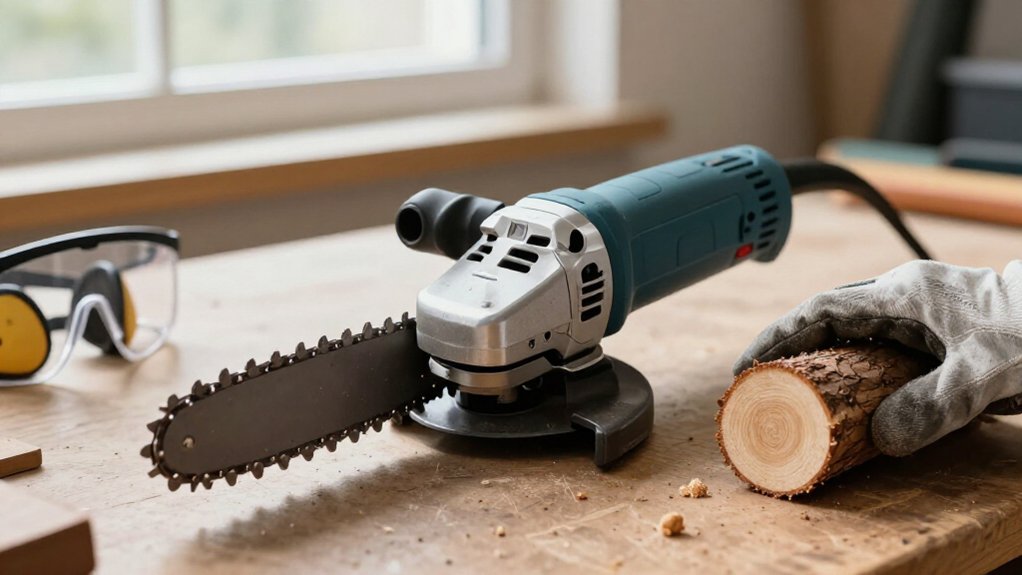
No. Don’t use chainsaw-style or toothed-saw attachments on an angle grinder; a snag can trigger violent kickback, wrenching the tool from your hands or driving it toward you.
Standard guards aren’t designed to control this hazard, and experience or a firm grip won’t make the setup safe. Matching the arbor or limiting cut depth doesn’t make these attachments suitable.
Stop using covered models, check OPSS alert PSA5, and use manufacturer-recommended accessories; more precautions follow.
Kickback Risk Verdict
Chainsaw discs and toothed saw blades shouldn’t be used with angle grinders: if they snag or strike the material, kickback can drive the tool toward you or wrench it from your hands.
These attachments create an unacceptable loss-of-control risk. If the chain or blade catches, you may lose your grip, and the tool can injure you or someone nearby with severe or fatal results. Your grinder’s safety features aren’t designed to manage this extra kickback risk, so don’t rely on them for protection.
OPSS says attachments that increase kickback and loss of control can’t meet essential machinery safety requirements. Stop using these attachments and dispose of them safely. Use only accessories approved for your grinder and task, following its instructions to work more safely.
Toothed Disc Hazard
A toothed saw blade or chainsaw disc can snag in wood, suddenly kicking the grinder back or wrenching it from your hands. This loss of control can cause fatal injuries to you and people nearby. An angle grinder’s guards and safety features aren’t designed to manage kickback risks from toothed attachments.
The hazard isn’t theoretical: BS EN 60745-2-3 requires warnings that chainsaw woodcarving blades and toothed saw blades can cause frequent kickback and loss of control. Don’t use toothed saw blades or chainsaw discs marketed for angle grinders. Instead, fit only attachments that your grinder’s manufacturer recommends, and check that each accessory suits the tool and task. If you’ve bought a toothed disc, stop using it; don’t assume experience or a firm grip will make it safe.
Kickback at Cutting Depth
As cutting depth increases, a chainsaw attachment can grip or snag the workpiece, abruptly kicking the grinder back or wrenching it from your hands.
At greater depth, teeth can bind. Torque may twist your hands, pull the tool off its path, or cause you to lose control. Don’t plunge the attachment deeply into material, and don’t assume a cut makes it safe.
Guidance for cutting wheels limits cut depth to twice the disc thickness, but that limit doesn’t validate a chainsaw attachment. A grinder’s guards and safety features aren’t designed to control kickback from toothed saw blades or chainsaw discs. The Office for Product Safety and Standards (OPSS) advises consumers to stop using these attachments because they can cause serious injury or death.
Arbor and Mounting Compatibility
Match the attachment’s arbor diameter to your grinder spindle, and use only the specified flange and locking nut. Never force or modify mounting parts, and remember that a matching arbor doesn’t make a chainsaw disc safe or compatible with an angle grinder. Use only attachments your grinder’s manufacturer recommends; if you’ve bought a toothed saw blade or chainsaw disc marketed for a grinder, stop using it and contact the seller about possible redress.
Arbor Size Compatibility
Before mounting any accessory, check that its centre-hole size matches the grinder spindle and use only the specified flange and locking nut. Never force, enlarge, or improvise a fit; an incompatible arbor or fitting can loosen at speed and create a serious hazard. Inspect the attachment and mounting parts for damage or defects before use; if you’ve dropped a component or find any damage, don’t use it.
Follow your grinder manufacturer’s mounting instructions and choose only attachment types it recommends. Correct sizing doesn’t make a toothed saw blade or chainsaw disc safe or suitable for an angle grinder; don’t use these attachments. A matching centre hole can’t control kickback or make an unsuitable cutting accessory safe. Stop if the arbor sizes don’t match exactly.
Mounting Hardware Fit
Confirm that the attachment’s arbor fits the grinder spindle exactly as both manufacturers specify, then use the specified flange and locking nut. Match the centre-hole size to the spindle; don’t force, modify, or substitute parts to make them fit. Use only the flange and locking nut approved for that attachment, because incorrect fittings can contribute to disc failure at high speed. Tighten hardware with the tool specified by the grinder manufacturer; improvised methods can damage the grinder or attachment.
Even a correct mechanical fit doesn’t make a chainsaw disc safe or suitable for an angle grinder. OPSS warns these attachments can cause severe kickback and loss of control. Don’t fit toothed saw blades or chainsaw discs; use only attachment types your grinder’s manufacturer recommends.
Secure Attachment Checks
A secure fit starts with checking the grinder and attachment manufacturers’ instructions for explicit compatibility; mounting physically doesn’t mean the attachment is safe or approved. Match the attachment’s arbor hole to your grinder’s spindle, then use only the flange and locking nut specified for that attachment. Don’t force a mismatch or modify, omit, or substitute mounting parts to make it fit.
Before use, secure the guard and auxiliary handle as directed, and inspect the attachment, flange, nut, and spindle for damage or defects. Don’t install a disc that’s been dropped or damaged; replace it instead. Most importantly, don’t mount toothed saw blades or chainsaw discs on an angle grinder. OPSS warns these attachments are unsuitable and can cause frequent kickback and loss of control. If compatibility isn’t explicit, don’t proceed.
Operator Training and Control
You need training in safe work procedures and one-on-one supervision if you’re new to angle grinders. Don’t use chainsaw-disc or toothed saw-blade attachments; if one’s fitted, stop and switch to an accessory the grinder’s manufacturer recommends. For ordinary grinding, secure the guard and auxiliary handle, hold the tool with both hands, let it reach speed before contact, and use light pressure to reduce snagging and loss of control.
Operator Competency
Before using an angle grinder, get training in its safe-work procedures, and make sure anyone unfamiliar with the tool receives one-on-one supervision. Your training should make clear that chainsaw discs and toothed saw-blade attachments sharply increase kickback and loss-of-control risks; never fit them to an angle grinder.
When you operate an approved setup, hold the grinder with both hands: keep one on the handle and dead-man switch, if fitted, and use the other to support the tool. Stand balanced and keep a clear view of the work; stop if you can’t control the tool or workpiece safely. Take regular short breaks to rest your hands and arms, since fatigue can weaken control. Never put the grinder down until its disc has fully stopped rotating.
Kickback Response Training
If a disc snags or the grinder kicks back, release the dead-man switch if fitted, keep both hands on the tool, and let the disc stop completely before setting it down. Know chainsaw-style or toothed-saw discs aren’t safe for angle grinders: they can snag, trigger violent kickback, and wrench the tool from your hands. Rehearse releasing the switch and waiting for a full stop; don’t force the disc through a cut.
Use the auxiliary handle and a firm two-handed grip, but understand these measures can’t make an incompatible attachment safe. Never bump or force the disc into work; it may catch and cause loss of control. If an attachment was sold as grinder-compatible, stop using it and contact the seller about possible redress.
Maintaining Secure Control
Maintaining secure control starts with choosing a safe, compatible attachment: never use a chainsaw disc or toothed saw blade on an angle grinder, because it can snag and cause severe kickback that jerks the tool from your hands.
Keep both hands on the grinder, with one on its handle and dead-man switch, if fitted, and the other supporting the tool. Maintain a firm, balanced stance and a clear view of the work. Let the grinder reach operating speed before contact; apply minimum pressure and don’t bump the disc against the work or an object.
Train with safe-work procedures, and provide one-on-one supervision if you’re unfamiliar with grinders. Rest your hands and arms regularly, and never set the grinder down until its disc has stopped rotating.
Specific Guarding Requirements
Keep the angle grinder’s manufacturer-approved guard securely fitted between you and the disc; it should cover at least half the disc.
A standard guard doesn’t protect you from the greater kickback and loss-of-control risks posed by toothed saw blades or chainsaw discs. Don’t use these attachments on an angle grinder: they’re not designed for the tool and can’t meet essential safety requirements. Never remove or modify the guard to make one fit.
Stop using the attachment and dispose of it safely. Before fitting an approved disc, check that the guard is securely attached and compatible with that disc. Also verify the disc’s rated speed exceeds the grinder’s operating speed; a mismatch can cause failure. If you can’t confirm either condition, don’t operate the grinder.
Wood-Dense Material Caveat
Dense or tough wood can make a chainsaw-style attachment snag or bind, suddenly twisting the grinder or throwing it from your hands and causing severe cuts. That danger can rise when the cut meets tightly grained, dry, or otherwise resistant material: the teeth may bite faster than you can correct the tool’s movement.
If the kerf closes around the chain, the attachment can bind and transfer force abruptly through the grinder. You may lose your grip or control before you can react, putting anyone nearby at risk as well.
An angle grinder’s safety systems aren’t designed to control kickback from a toothed chain, so lighter wood won’t make this pairing safe. Treat binding as a loss-of-control hazard, not a cutting problem.
Ignoring Manufacturer Safety Alerts
When a safety alert identifies a chainsaw disc or toothed blade for an angle grinder, don’t ignore it: OPSS warns these attachments can snag, trigger severe kickback, and cause fatal loss of control.
Treat the alert as a stop-use warning, not routine maintenance; skill can’t remove the attachment’s design hazard.
- A blade can snag or grip wood, abruptly turning the grinder or wrenching it from your hands.
- Its built-in guards and controls aren’t designed to manage this added kickback risk.
- These attachments don’t meet essential safety requirements for angle-grinder use.
- Stop using an in-scope attachment immediately; continued cutting can expose you and bystanders to fatal injury.
- Dispose of it safely, and contact the seller if it was marketed as compatible to seek redress.
Check the OPSS Safety Alert
Check OPSS Product Safety Alert PSA5 and its Consumer Safety Alert Poster to confirm whether your toothed saw blade or chainsaw-disc attachment is covered.
OPSS warns that these attachments can snag the workpiece, making the grinder kick back sharply or fly from your hands. Its safety features aren’t designed to control this hazard; loss of control can cause serious injury or death. Under the Supply of Machinery (Safety) Regulations 2008, products that raise these risks can’t meet essential safety requirements, so businesses must remove non-compliant models from sale. If your attachment matches the poster, stop using it immediately and contact the seller if it was sold as angle-grinder compatible.
| Alert | Risk | Action |
|---|---|---|
| PSA5 | Kickback | Check |
| Poster | Images | Compare carefully |
| Covered | Injury/death | Stop |
| Seller | Compatibility | Contact |
Conclusion
Treat an angle-grinder chainsaw attachment as a high-risk setup, not a safe shortcut. Its toothed disc can catch at cutting depth and trigger violent kickback before you can react. Don’t use one unless the grinder, arbor, attachment, guard, and instructions explicitly approve the combination; training can’t correct incompatible hardware.
Avoid dense wood and keep control, but don’t rely on technique alone. Check the OPSS Safety Alert and follow its guidance before operating, or choose a purpose-built chainsaw.