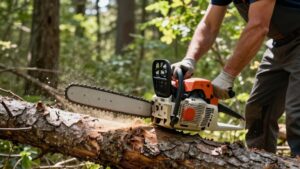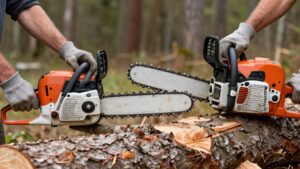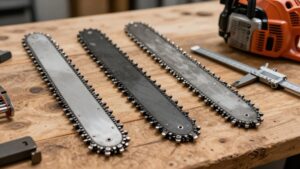
Types of Chainsaw Chains: Full Chisel, Semi-Chisel, Low-Profile and Ripping
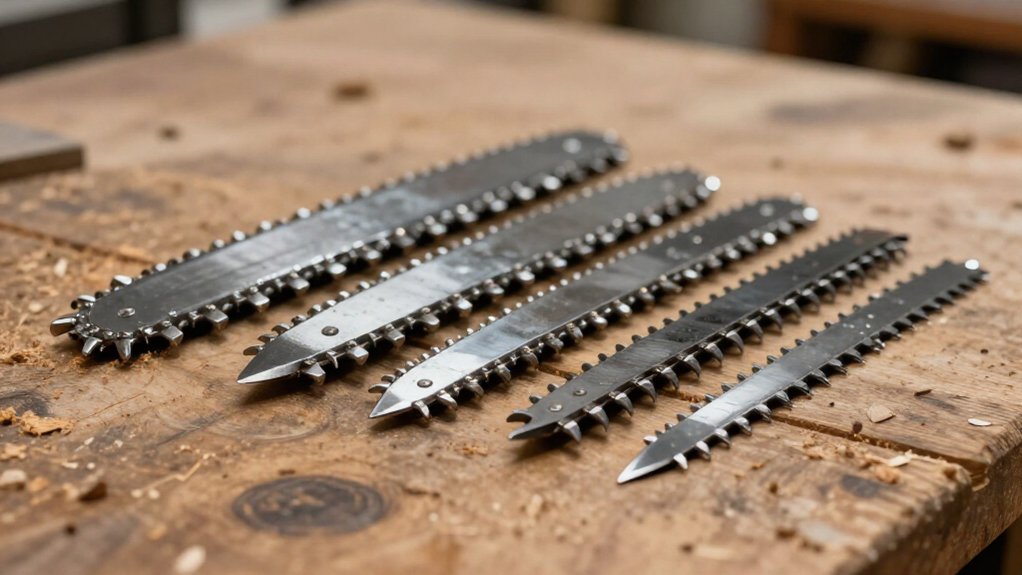
Full-chisel chains cut clean wood quickly but dull faster in grit and need precise filing. Semi-chisel cutters resist abrasion and suit dirty or storm-fallen wood.
Low-profile chains use shorter cutters and lower depth gauges to reduce kickback risk, but you must still control the saw. Ripping chains cut parallel to the grain, typically with a 10-degree filing angle.
Match pitch, gauge, and drive-link count; continue for sharpening and setup details for safer cutting.
Identify Chain Tooth Shapes
To identify a chainsaw chain’s tooth shape, look at the cutter’s working corner and edge.
Full-chisel cutters have square corners and sharp edges, so they cut quickly and aggressively in clean wood. Their geometry demands careful handling and sharpening; avoid contact with the moving chain and wear protective equipment. Semi-chisel cutters have rounded corners that resist dulling in dirty, frozen, or mixed wood. You can also sharpen them more easily.
Chipper cutters round the working corner further than semi-chisel cutters, and their cross-section resembles a question mark. Micro-chisel cutters have smaller, slightly rounded corners than full-chisel cutters, making them less aggressive and easier to sharpen. Chamfer-chisel cutters use a 45-degree bevel between the plates rather than a rounded corner. Compare these profiles and choose according to wood conditions, cutting needs, and your ability to maintain the edge safely.
Pitch, Gauge, and Drive Links
Although chain teeth determine how a chain cuts, pitch, gauge, and drive-link count determine whether it fits your saw. Pitch is the average distance between chain rivets. Common sizes are 1/4″, .325″, 3/8″, and .404″. Match the chain’s pitch to both the guide bar and drive sprocket; a mismatch can prevent correct operation.
| Item | Meaning | Check |
|---|---|---|
| Gauge | Drive-link thickness | Match bar groove |
| Length | Required drive-link count | Count old chain |
Gauge is the drive-link thickness, and it must match your guide-bar groove. An oversized chain won’t fit; an undersized one may wobble. To replace a chain, count the old chain’s drive links and match that number. Don’t guess or force a chain into place. Check three specifications against your saw’s manual before installation, then tension and inspect it as directed.
Ripping Chain Grain-Cutting Geometry
When you mill logs into planks or beams, a ripping chain cuts along the grain using cutters filed at a shallower angle, typically about 10° versus roughly 30° for cross-cutting. Its side-plate geometry scrapes wood into sawdust, while raker depth and clearance affect cutting action and chip evacuation. Use the correct chain and follow the saw and mill manufacturers’ safety instructions.
Milling Along the Grain
Milling lumber requires a ripping chain, whose cutters are filed at a shallow angle, typically about 10°, compared with roughly 30° for crosscutting.
When you mill a log into planks or beams, the chain travels parallel to the grain rather than across it. Its cutters scrape wood fibers, producing sawdust instead of the chips typical of crosscutting. That action suits longitudinal cuts and helps you create boards from a secured workpiece. Ripping chains commonly use a full-component cutter arrangement to support an even cut along the length of the timber.
Match the chain to your mill and saw, and follow the manufacturer’s setup and operating limits. Secure the log, keep the guide bar aligned with your intended cut, and maintain firm control throughout each pass. Wear appropriate protective equipment, inspect the chain before use, and stop the saw before adjustments or clearing debris or performing any maintenance.
Cutter Angle and Geometry
For cuts along the grain, a ripping chain uses cutters filed at a shallow angle, typically about 10°, compared with roughly 30° for crosscutting. This geometry suits milling because the cutters travel parallel to wood fibers. Instead of chipping across them, they scrape along the grain and produce sawdust. That action helps you form planks or beams, but it doesn’t make the chain a substitute for a configured milling setup.
Ripping chains commonly use full-component layouts, with cutters spaced closely to support an even cut along the log. Keep the chain sharp and tensioned to the saw maker’s specifications; inspect it before each cut. Secure the workpiece, maintain stable footing, and follow your mill and chainsaw instructions. Don’t force the saw: let the cutters advance steadily.
Side Plate Filing Angle
Side plate filing angle shapes how a ripping chain engages wood fibers along the grain.
A ripping chain uses a shallower side plate filing angle, typically about 10°—than the roughly 30° angle common in crosscutting. This geometry suits milling because the cutters work along the log’s grain, scraping fibers rather than slicing across them. That action produces sawdust as you turn logs into planks or beams.
Keep the filing angle consistent from cutter to cutter; uneven angles can make the chain cut irregularly and complicate control. Check your chain manufacturer’s specifications before filing, since the recommended angle can vary by chain design. Use the specified file and guide, secure the saw with its engine off, and wear eye and hand protection. Don’t assume one angle fits every ripping chain; follow the model-specific instructions to maintain predictable cutting performance.
Raker Depth and Clearance
Although ripping-chain cutters use a shallow filing angle, usually about 10°, to scrape along the grain, raker clearance controls how deeply they bite.
Your depth-gauge setting determines cutter engagement. Too little clearance slows the cut; too much can make the chain grab aggressively, increasing kickback risk and reducing control. Follow the chain manufacturer’s specified setting for your exact model; don’t substitute a general measurement, because designs differ.
Whenever you sharpen the cutters, check raker height. Filing lowers each cutter’s top plate, which can leave its raker too high to maintain clearance. Adjust rakers as the manufacturer directs, using the correct depth-gauge tool and procedure. Keep heights even along the chain so each cutter takes a consistent bite, rather than alternating between shallow and aggressive engagement.
Chip Size and Evacuation
A ripping chain follows the grain, scraping wood into sawdust rather than producing the larger chips typical of crosscutting. Its cutters use a shallower filing angle, usually about 10 degrees, compared with roughly 30 degrees for crosscutting. This geometry changes how each cutter separates fibers, so you should expect fine sawdust, not broad chips.
With a full-component ripping chain, closely spaced cutters help you maintain a more even cut along the grain. That consistency suits chainsaw milling, where you turn logs into planks or beams and need a uniform surface. Keep the chain and milling setup appropriate for the saw, and use required protective equipment; sawdust and debris can still be ejected toward you during operation, even in controlled milling conditions.
Feed Rate and Cutting Pressure
Because ripping cutters scrape parallel to the grain rather than taking larger cross-grain chips, they remove material less aggressively and produce fine sawdust. Their shallower filing angle, usually about 10°, compared with roughly 30° for cross-cutting, sets this grain-cutting geometry. As you mill planks or beams, maintain a steady feed and apply even pressure so the chain advances uniformly.
Don’t force the saw; excessive pressure can bog down the motor, reducing control and stressing the power unit. Let the cutters work at a consistent rate, keeping your stance stable and hands on both handles. If cutting resistance changes, ease feed pressure rather than pushing harder. Ripping chains commonly use a full-component cutter arrangement, which supports a smoother, more even cut along the grain during milling.
Kerf Width and Surface Finish
Feed pressure affects how smoothly a ripping chain advances, while kerf width determines how much wood it removes. A ripping chain is filed to a shallower cutter angle, typically about 10 degrees rather than roughly 30 degrees for cross-cutting. This geometry lets the cutters scrape along the grain, producing sawdust instead of chopping across fibers. That action suits milling logs into planks or beams; a full-component cutter arrangement can help you obtain an even surface.
A narrow kerf removes less wood and may ease work for a small or battery-powered saw. However, it can bind more readily in a cut or when the bar is pinched. Keep the cut supported and watch for closure; stop if the kerf tightens, then free the bar safely.
Matching Chain to Lumber Tolerance
When milling lumber, match the chain to the cut’s direction and the finish you need. A ripping chain cuts along the grain, so choose it when you mill logs into planks. Its cutters use a shallower filing angle, about 10°, compared with 30° for cross-cutting. This geometry scrapes wood fibers rather than chipping them, producing sawdust and helping you achieve an even grainwise surface. Ripping chains use a full-component cutter arrangement to support a consistent finish. A standard cross-cut chain targets cuts across the grain; it isn’t the right choice for milling.
Match chain selection to the lumber tolerance your project requires, and verify the chain maker’s specifications before fitting it. Secure the workpiece, follow the saw’s operating instructions, wear appropriate protective equipment, and keep bystanders clear.
Chain Arrangement Differences
When you compare chain arrangements, you’ll find that full-skip chains clear chips efficiently on long bars, while semi-skip chains balance chip clearance with smoother cutting. Full-complement chains use more cutters for smoother cuts but create more drag and need more frequent sharpening. You should also consider how ripping-chain arrangements suit grain cutting, and always match the chain to your saw and bar specifications.
Full-Skip Chains
Full-skip chains space cutters farther apart, typically placing two drive links between them, so they have fewer teeth than full-component chains.
The wider spacing reduces cutting drag and motor strain while letting chips clear readily. You can use this arrangement for large logs and thick rounds, especially with guide bars 24 inches or longer. In clean softwood, it supports fast, rough cutting, but the cut surface is less smooth than one made with a full-component chain. On short bars, full-skip chains may rattle and produce messy cuts, so avoid them for fine work.
Fit the chain only to a compatible saw and bar, following the manufacturer’s specifications. Keep the chain properly tensioned and sharp, and you maintain a firm grip with secure footing.
Semi-Skip Chains
Semi-skip chains place cutters farther apart than full-component chains but closer together than full-skip chains. Their alternating pattern leaves one tie strap between some cutters and two between others, opening additional space for chips to clear.
You get a cleaner cut than with a full-skip chain while retaining some of its reduced drag. This arrangement can suit general cutting with medium bars around 18 to 24 inches, provided the chain matches your saw’s specifications and the wood and task. Some semi-skip designs serve specific hardwood projects, often on bars longer than 24 inches. Before cutting, verify chain pitch, gauge, drive-link count, and bar compatibility; wear appropriate protective equipment and maintain secure footing. Don’t choose spacing alone: operating conditions and manufacturer guidance should determine your setup safely.
Full-Complement Chains
Full-complement chains pack the maximum number of cutters onto a given chain length, producing smoother cuts than skip-tooth arrangements. The closely spaced cutters engage wood frequently, which increases drag and places a greater cutting load on your saw. Use this arrangement when your saw has sufficient power, with guide bars under 18 inches, precision work, hardwoods, or cuts where surface finish matters.
You can run a full-complement chain on a bar under 20 inches if the powerhead can sustain its load. Compared with skip-tooth chains, it clears fewer large chips, so maintain a cutting edge and avoid forcing the saw through the cut. Expect to sharpen it more often. Match the chain to your saw’s specifications, and follow the manufacturer’s operating and maintenance guidance.
Ripping Chain Arrangements
For milling lumber, ripping chains commonly use a full-complement arrangement, with closely spaced cutters that produce a consistent, even cut for planks or beams. That layout suits chainsaw milling because you can produce uniform stock. Full-complement chains place the maximum number of cutters along the chain.
By contrast, a skip-tooth chain spaces fewer cutters farther apart, reducing drag and helping clear chips when you mill large logs. However, you should expect a rougher surface than with a full-complement setup. Semi-skip chains alternate spacing patterns and often include one or two tie straps between cutters.
They generally suit medium bars measuring 18 to 24 inches. Before fitting any arrangement, check your saw and bar specifications; a chain must match both. Secure the workpiece, keep the bar clear of the ground, and follow the saw maker’s milling guidance. Choose skip-tooth for chip clearance on large logs, or full-complement for smoother, even cuts.
Bucking Storm-Fallen Oak
Storm-fallen oak often carries soil and grit that can quickly dull a chain. Before bucking, inspect the log for contamination and embedded debris; brush or remove material from the cutting path. A semi-chisel chain is the practical choice because its rounded cutters retain an edge longer in gritty conditions. Choose full chisel only when the oak is clean and cutting speed matters: its square-cornered cutters cut aggressively, but dirt and abrasive debris can dull them quickly.
Match chain pitch and gauge to your saw’s bar and drive sprocket, and fit the exact drive-link count specified for the bar. Keep the chain sharp and correctly tensioned. Check cutter lengths; uneven cutters can make the saw pull to one side. Sharpen or replace the chain as needed.
Chain Kickback and Pinching
Chain choice affects kickback risk and how the saw responds if the bar pinches. Low-profile chains use shorter cutters and lower depth gauges, features intended to reduce kickback risk. Semi-chisel cutters have rounded corners and generally pose less kickback risk than full-chisel cutters. Full-chisel chains cut aggressively, but their higher kickback risk calls for careful control and a secure stance.
Narrow-kerf chains remove less wood, yet they may bind more readily when a bar pinches in a large cut. Keep the chain, guide bar, and drive sprocket pitch matched; mismatched components can jam the chain and lock the bar. If you feel binding, stop cutting, release the throttle, and secure the saw before addressing the obstruction; never pull a trapped bar free under power.
Chain Sharpening Angles
Although standard cross-cut chains are typically filed at about a 30° top-plate angle, ripping chains use a shallower angle of about 10° so their cutters scrape along the grain and produce sawdust. Choose the file and technique for your cutter type; don’t force one angle across every chain. Full-chisel cutters demand precise filing to retain sharp, square corners.
Semi-chisel cutters tolerate angle variation better. Keep each cutter the same length, since uneven cutters can pull the saw off line. Before sharpening, shut off the engine, engage the chain brake, wear gloves and eye protection, and secure the bar. Follow the chain maker’s specifications when available; the angles here are typical, not universal.
- Check top-plate angle.
- Use matching files.
- Sharpen consistently.
- Recheck cutter lengths.
Conclusion
Choosing a chainsaw chain means matching tooth shape and geometry to your wood, saw, and cutting direction. Check pitch, gauge, and drive-link count against the bar before installation. Use ripping chain only for milling along the grain; select crosscut chain for bucking storm-fallen oak.
Keep cutters sharpened to specified angles, and inspect for damage. Maintain footing, avoid pinching the bar, and stay out of the kickback zone. Wear protective equipment and follow saw instructions.
Chainsaw Chain Speed Calculator
Turn RPM, drive sprocket teeth and chain pitch into chain speed in ft/s, m/s, mph or km/h, and compare 7- vs 8-tooth sprockets.
Chainsaw File Size Finder
Pick your chain pitch or type the number stamped on your chain to see the round file size STIHL and Oregon publish for it.
Chainsaw Mill Bar Length & Max Log Width Calculator
Find the widest log your bar can mill after your mill's allowance, or the bar length you need for a given log, in inches or mm.