How Long Does a Battery Chainsaw Last on a Charge? Real Runtime by Ah
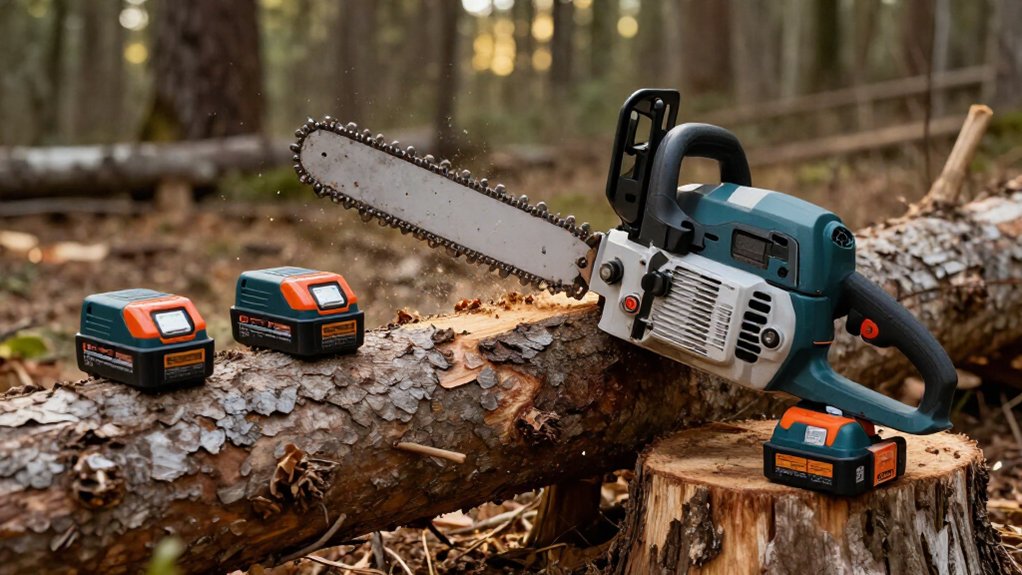
Expect a battery chainsaw to run about 20 to 50 minutes per charge. A 2-Ah pack often lasts 20 to 30 minutes, while a 5-Ah pack may reach 30 to 50 minutes under similar conditions.
Heavy cutting, dense wood, cold weather, or a dull chain can shorten runtime; cold alone may reduce it by 20 to 30%. Your actual result depends on voltage, motor efficiency, wood, and cutting pace. Keep the chain sharp and compare watt-hours for energy. Below, you’ll find practical estimates.
Ah-based Runtime Estimates
Battery capacity gives you a useful runtime estimate, but not a guarantee: a 2 Ah pack may run for about 20 to 30 minutes, while a 5 Ah pack often lasts 30 to 50 minutes. Under light to moderate cutting, you can expect the 5-Ah pack to outlast the 2-Ah pack, but don’t assume runtime will scale exactly with capacity. Heavy, continuous work, particularly in dense wood, can push either battery toward the low end of that range.
Saw efficiency and cutting conditions matter too: a tested EGO CS2005 with a 6-Ah battery ran about 35 minutes, while a Milwaukee M18 FUEL ran about 33 minutes. For practical planning, a full charge may cover roughly 30 to 80 typical homeowner cuts. Your actual count will vary with log size, wood density, chain sharpness, and cutting intensity. Track results when scheduling longer sessions.
Battery Size and Voltage
To compare battery size, separate voltage from amp-hours: voltage supports the saw’s power, while Ah indicates how much charge the pack stores. Under similar cutting conditions, a 5Ah pack generally runs longer than a 2Ah pack because it stores more charge; it doesn’t necessarily deliver more power. Choose voltage for the saw’s power needs, then compare Ah to estimate how long you can work before swapping or recharging.
Higher voltage and Ah can sustain power and extend runtime, but they don’t guarantee a fixed duration: motor efficiency and cutting workload also affect consumption. For reference, the EGO CS2005 ran about 35 minutes in testing with its included 6Ah battery; its smaller 5Ah and 2.5Ah packs offer less runtime. Match capacity to your priorities: a larger pack gives you more time between charges, while a smaller one can reduce saw weight if it matches your saw’s requirements.
Typical Job Runtime Examples
For pruning and occasional trimming, a 5 Ah pack typically lasts longer than a 2 Ah pack, though your saw and cutting conditions determine the difference. You’ll get more time from light-to-moderate cuts than from sustained bucking; continuous firewood work can push a charge toward the low end of the 20 to 50 minutes of intermittent use.
A 4 Ah pack may cover a weekend firewood session with roughly 30 to 80 homeowner cuts per charge; log diameter and wood species shift that count. STIHL rates the MSA 60 C-B at up to 40 minutes with an AK 20 and 55 minutes with an AK 30 S. Tests logged about 35 minutes for the EGO CS2005 with 6 Ah and 33 minutes for Milwaukee M18 FUEL.
Battery Pack Cell Configurations
Cells connected in series raise pack voltage, while parallel arrangements can increase capacity in amp-hours (Ah). You’ll use voltage to gauge power and Ah to estimate runtime; a 5 Ah pack typically runs longer than a 2 Ah pack under comparable cutting conditions. Configuration matters, but your saw’s efficiency and workload also affect how long the charge lasts.
Series And Parallel Cells
A battery pack’s series and parallel connections determine how its voltage and capacity combine. In a series string, each cell’s voltage adds to the next, while amp-hour capacity stays roughly unchanged. For example, several 1.2-volt cells in series raise pack voltage without multiplying its Ah rating.
Parallel cells work differently: voltage stays constant, but their amp-hour ratings add, increasing stored energy and potential cutting time. That’s why cell count alone won’t tell you how long your chainsaw will run; the arrangement matters. Compare packs using their voltage and Ah ratings, or multiply them to find watt-hours (Wh). All else equal, a pack with more Wh can supply more work. Your actual runtime still depends on wood, chain sharpness, cutting pace, and operating conditions.
Voltage And Capacity
Voltage and amp-hours describe different aspects of a chainsaw battery: voltage relates to the power available, while Ah indicates stored charge and generally predicts runtime. On the same voltage platform, a 5 Ah pack usually runs longer than a 2 Ah pack, but cutting load and motor efficiency affect the gap. Series-connected cells raise pack voltage; each NiMH cell contributes about 1.2 V.
| Pack | Voltage role | Capacity role |
|---|---|---|
| 2 Ah | Same platform | Lower stored charge |
| 5 Ah | Same platform | Higher stored charge |
| Choice | Match saw | Balance weight/runtime |
Compare voltage and Ah together, then confirm platform compatibility before buying. A larger-capacity pack may add weight, changing saw balance and increasing fatigue, so weigh handling against the runtime you need for your cutting tasks and workload.
Configuration And Runtime
Within a battery pack, cell configuration determines how cells combine to provide the saw’s voltage and capacity, but it doesn’t set runtime on its own. With the same voltage and similar cutting conditions, a 5-Ah pack will generally run longer than a 2-Ah pack. However, Ah alone can’t predict minutes: voltage, motor efficiency, and cutting load also affect energy use.
Heavy, continuous cuts drain the battery faster than light pruning or intermittent trimming. When you choose capacity, weigh handling. A larger pack may extend work time but adds weight and can change saw balance; a smaller pack feels lighter but needs recharging sooner. For a useful comparison, check the manufacturer’s runtime estimates for each battery and saw combination, since results vary by tool and pack.
Cold-Weather Battery Performance
Cold weather can cut your chainsaw’s runtime by roughly 20 to 30%, turning a typical 30 to 40 minutes into about 21 to 32 minutes. Keep the battery warm before use when practical, since extreme cold and continuous heavy cutting can reduce runtime further. For winter storage, choose a cool, dry place and avoid temperature extremes that can impair performance or damage the pack.
Cold-Weather Runtime Loss
When temperatures drop, expect a battery chainsaw to run about 20 to 30% less time per charge: a pack that normally lasts 40 minutes may deliver only 28 to 32 minutes.
That reduction can turn a planned cutting session into an early battery swap, so base your workday on cold-weather runtime rather than the label’s best-case estimate. In extremely cold conditions, available output may fall further, and continuous heavy cutting accelerates the loss because the motor draws substantial current without recovery breaks.
Pack condition also changes the result: an older battery may already hold less charge than when new, and cold can further limit the energy it can deliver. If your saw’s usual runtime is 30 minutes, a 20 to 30% reduction means roughly 21 to 24 minutes in comparable cold use. Treat these figures as estimates, since temperature, cut size, chain sharpness, and workload affect actual runtime. Track minutes across similar jobs to estimate your own cold-weather margin.
Battery Warming Strategies
To limit the 20 to 30% runtime loss that cold weather can cause, keep your battery warm before cutting and let a chilled pack reach a moderate temperature before use. Carry the pack indoors or in a warm vehicle, then install it shortly before you start; don’t leave it exposed to freezing air between cuts. A cold lithium-ion pack can deliver less power and drain faster, so warming it helps preserve usable capacity, though it won’t restore energy already spent.
Follow your saw maker’s temperature limits, and don’t heat the battery with a flame, heater, or other direct source. If the pack feels cold, wait until it reaches a moderate temperature before charging, too. Your cutting technique still matters: dense wood and a dull chain raise motor load, worsening cold-weather runtime loss. Keep the chain sharp and use steady cuts to reduce current demand and stretch each charge, especially during long, heavy cutting sessions.
Safe Winter Storage
Store your chainsaw battery in a cool, dry place away from sunlight, moisture, flammable materials, and temperature extremes. For winter downtime, leave a lithium-ion pack near 50% charge. Don’t store it fully depleted or keep it connected to the charger after it reaches full charge.
Follow your manufacturer’s storage and charging instructions.
Cold weather can cut runtime by roughly 20 to 30%; extreme cold may drain the battery faster. When practical, keep the pack warm before cutting, but don’t use external heat. Before using a cold-stored battery, let it warm to room temperature and inspect it for cracks, leaks, or corrosion. If it’s wet, dry it thoroughly before installation or charging.
During long storage, check its charge periodically and recharge as directed to maintain readiness.
Storm-Damaged Branch Cleanup
For storm-damaged branch cleanup, expect about 20 to 50 minutes of intermittent cutting per charge, with continuous heavy cutting pushing runtime toward the low end. A fully charged battery may deliver roughly 30 to 80 typical homeowner cuts, but thick or hard storm-felled wood drains it faster than smaller branches.
A 5 Ah pack generally lasts longer than a 2 Ah pack during light-to-moderate work, though branch diameter and wood density affect demand. Cold weather can cut runtime by about 20 to 30%, so keep spare packs warm and charged before heading out.
For cleanup lasting several hours, plan on three or four batteries and rotate them as needed; don’t assume one charge will cover a full storm debris pile. Check charge between sections to pace your cleanup work safely.
Chain Sharpness and Runtime
A sharp, properly tensioned chain cuts efficiently, putting less strain on the motor and helping your battery last longer per charge. A dull chain needs more energy to cut, so it can reduce runtime, particularly during heavy or continuous work. Keep the cutters sharp and check chain tension regularly as part of routine maintenance. Correct tension helps the chain track and cut as intended; don’t run it loose or overtightened.
If each cut starts taking longer or your saw seems to labor, inspect the chain before assuming the battery has lost capacity. Sharpen or service it as needed, then reassess performance under similar conditions. Even with a sharp chain, runtime varies: dense wood and demanding cuts still draw more power. Sharpness improves efficiency, but it can’t remove the added load from hard wood or intense cutting.
Overestimating Cuts per Charge
Even with a sharp, properly tensioned chain, don’t treat a full charge as a fixed number of cuts. Homeowner estimates commonly span 30 to 80 cuts; another benchmark is 40 to 100 logs, each 6 to 10 inches. These ranges describe conditions, not guarantees. Your wood species, diameter, pace, and temperature can shift results sharply.
- Dense oak drains more energy than pine, so expect fewer cuts from the same pack.
- Heavy, continuous cutting may bring runtime toward 20 to 50 minutes’ low end; pauses let the motor and battery recover between bursts.
- A dull chain raises motor load and energy use, cutting your achievable count even if logs stay small.
- Cold conditions can trim runtime by roughly 20 to 30%, making warm-weather cut totals poor planning figures.
Record results by pack, wood, and weather.
Check Your Charger Compatibility
Before charging, confirm that the charger matches your chainsaw battery’s voltage and platform; a plug that fits doesn’t prove compatibility.
Use the charger specified by the chainsaw or battery manufacturer; check its label and model number against your pack. If you own tools on a shared battery platform, verify that the charger supports that system; compatibility across tools doesn’t automatically confirm charger support. Use the supplied charger when possible. Charging with a mismatched unit can create a safety risk.
Don’t charge the battery if it’s wet or damaged. Look for cracks, leaks, or corrosion, and contact the manufacturer if you find signs of damage. Once charging ends, unplug the battery rather than leaving it connected for an extended period.
Conclusion
A battery chainsaw’s runtime depends on more than amp-hours: voltage, cell configuration, temperature, chain sharpness, and cutting load all matter. Use Ah-based estimates as a starting point, then adjust for cold weather, storm-damaged wood, and the size of each cut. Keep a sharp chain and a compatible charger to protect performance. For reliable planning, carry a spare charged pack and track how long your saw runs on your typical jobs; your measured runtime beats any estimate.
Battery Chainsaw Runtime Estimator
Estimate battery chainsaw runtime from battery voltage, amp-hours, rated watts and duty cycle, with an optional corded-saw energy comparison.
Battery vs Gas Chainsaw Cost-of-Ownership Calculator
Compare the total cost of a gas and a battery chainsaw over the years with your own fuel, power and usage numbers, and find the break-even point.