How to Store Chainsaw Batteries in Winter to Protect Capacity
To protect your chainsaw battery’s capacity over winter, store it indoors in a dry, secure place within the temperature range in its manual, away from freezing conditions, sunlight, and heat. For lithium-ion packs, use the maker’s storage charge, often about 40% to 60%, and check it periodically; store lead-acid batteries fully charged.
Use only the specified charger, and never charge cold cells or a damaged pack. Inspect weekly, record charge and condition, and learn when to act.
Cold-Weather Capacity Protection
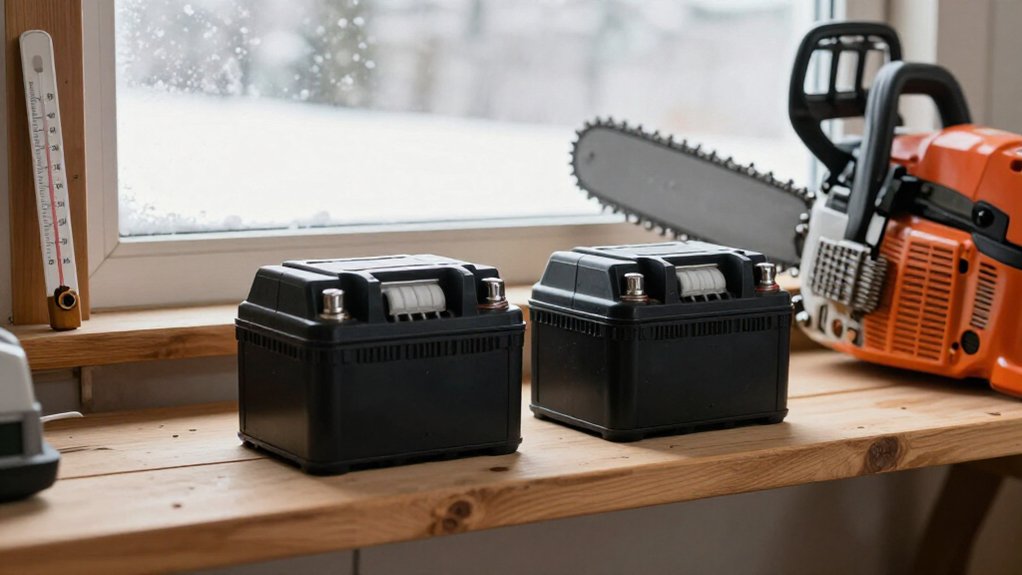
To protect capacity during winter, store chainsaw batteries indoors at a stable 15 to 20°C (50 to 68°F), in a dry place away from direct sunlight, not in a freezing shed or garage.
Cold can temporarily reduce available capacity, so keep your battery warm until use. If you operate the saw in low temperatures, expect shorter run time and plan work accordingly. Don’t mistake temporary power loss for permanent failure; cold limits energy delivery. Check charge periodically, since self-discharge can lower it during storage.
Recharge if it approaches a dangerously low level to prevent damaging deep discharge. Keep the battery dry and shielded from sunlight; moisture can corrode components and shorten service life. After use, return it indoors and let it warm before operating again. Handle it carefully and inspect for visible damage.
Battery-Maker Storage Limits
Once a chainsaw battery is warm and protected from moisture, check its manual for model-specific storage limits. Temperature and charge guidance can vary by model and chemistry, so don’t apply another pack’s limits.
- Keep the battery inside its specified temperature range; one maker’s example allows 14°F to 122°F.
- For maximum life, some makers advise 50°F to 68°F and 40% to 80% charge; follow the indicator’s instructions.
- If your tool has an integrated battery, one maker recommends 50°F to 68°F and 40% to 60% charge.
- Don’t store every battery fully charged: use its manual’s specified partial charge, if applicable.
Some integrated-battery manuals warn that storage above 86°F may reduce runtime and performance; treat that limit as model-specific, not universal, and keep the pack away from heat sources that could exceed its rated storage range.
Four-Week Inspection Calendar
A four-week inspection calendar can catch storage problems before they affect battery safety or performance. Set a weekly reminder, and inspect the battery without connecting it to the saw or charger.
| Week | Check |
|---|---|
| 1–2 | Inspect condition and verify manual-directed charge |
| 3–4 | Check terminals, isolation, charge, and storage conditions |
During week one, keep the clean, dry, undamaged pack indoors, above freezing, away from sunlight and metal. In week two, use the charge indicator; lithium-ion packs often need roughly 40–60%, but follow the maker’s target. In week three, look for swelling, leakage, moisture, or corrosion, and leave terminals disconnected. During week four, recheck charge and conditions. Recharge only when the manual calls for it. Note any change before repeating.
Date Each Battery
Label each battery with its identification and purchase date, and record the date you place it in storage. Note its last charge, voltage, and condition, including any swelling, leaks, or damage. Date each inspection and record maintenance so you can track storage time and avoid leaving batteries unchecked for more than six months.
Record Battery Identification
To keep winter storage records tied to the correct battery, mark each one with its identification or serial number and the storage date. Use a label that stays legible in cool, damp conditions, and place it where it won’t cover vents, contacts, or safety markings.
In your dated log, repeat the identifier and record the battery’s charge level and physical condition on that date. Note damage, swelling, corrosion, or changes without handling a compromised battery unnecessarily; follow the manufacturer’s safety instructions. Each time you inspect or recharge a battery, add the check date for each battery and updated condition and charge information. These entries let you compare batteries and spot one approaching six months in storage, so you can prioritize a timely check.
Note Purchase Dates
Record each chainsaw battery’s purchase date on the pack or its label, and note its model and purchase date in your storage log so you can distinguish identical-looking batteries. Enter the date before winter storage, while you can verify which pack the entry describes. Use a durable, legible label that won’t cover vents, terminals, or safety markings; don’t write where ink or adhesive could interfere with contacts.
Keep the log with your maintenance records, and associate every entry with the battery’s model and identifying details. This dated record lets you compare a pack’s age with later charge acceptance, runtime, or other performance changes without confusing it with a similar unit. If you replace a battery, create a new entry for the replacement rather than carrying over the old pack’s date. That keeps storage and service history attached to the correct battery and supports informed inspection or replacement decisions throughout the winter storage period.
Mark Last Charge
Before storing each chainsaw battery, note its last-charge date and charge level on its individual label or in your storage log. Record the charge level beside the date; lithium-ion batteries generally store best at a partial, not full, charge. Keep each label with its battery, using a method that leaves vents, contacts, and warnings unobstructed.
In a log, identify each battery to prevent records from getting mixed up. Use the date to schedule charge checks during winter, especially for storage lasting several months. Update the date and charge level after every recharge. This record helps you identify batteries that may need attention without relying on memory. Before use, confirm charge with the battery’s indicator or charger; a date alone doesn’t establish charge.
Track Storage Conditions
Once you’ve noted each battery’s last charge, date it when you put it into storage so you can track how long it remains stored. Label the battery or its storage container with the storage date, and enter that date in a separate record tied to the battery’s model or serial number. Include its charge level and visible condition at intake; clear entries help you distinguish batteries and identify changes later.
Keep the record with your maintenance documents, not loose near terminals, where metal objects could create a short circuit. Use the elapsed-storage information to flag batteries nearing six months and recharge only as needed, following the manufacturer’s instructions. Record swelling, leakage, corrosion, or other damage. Don’t put a damaged battery back into storage; isolate it and follow the manufacturer’s disposal or service guidance.
Update Inspection Dates
At each inspection, write the date on that battery or its storage label, and note its charge level and physical condition. Date each battery individually; don’t rely on one reminder for the entire set, because batteries may have different inspection histories. Record charge level consistently, and describe the case and terminals before placing it back in storage.
Note any damage, swelling, leakage, or other change; don’t handle or charge a battery that appears damaged or swollen. Follow the manufacturer’s guidance to set the next inspection date, especially when storage will last several months. Put that date beside the current entry or in a battery-specific log, then check it when due. Clear records help you identify missed inspections and act promptly if a battery’s condition changes.
Adjust for Battery Age
Assess each battery’s age and inspect it for swelling, cracks, leaks, or corrosion; don’t store or use a damaged battery. Store lithium-ion batteries at about 40% to 60% charge, follow the manufacturer’s instructions, and check older batteries every few months because they may self-discharge faster. If a battery loses charge unusually fast or won’t hold a charge, have it assessed or recycle it rather than relying on it for spring use.
Assess Battery Age
Before winter storage, check your chainsaw battery’s age and condition: older batteries may self-discharge faster and have less capacity to withstand prolonged storage. Use the manufacture date, purchase record, or service history to estimate age; don’t rely on appearance alone. Before storing an older pack, inspect its case, terminals, and seams under light. Swelling, cracks, leakage, or corrosion indicate damage.
Don’t store or charge a damaged battery; arrange recycling through an approved collection program. During winter, check an older battery more often for unexpected discharge, following maker instructions. A pack that repeatedly loses charge or gives shorter runtime may have degraded cells. Have a qualified provider assess it, or replace it before next season. Don’t open the casing; lithium-ion packs can present fire and electrical hazards.
Adjust Charge Levels
For a lithium-ion chainsaw battery in good condition, store it at about 40–60% charge, not full or empty. If your battery is older or shows noticeable self-discharge, check its charge more often through winter. Top it up before it drops below the manufacturer’s safe storage level; don’t let it sit depleted. For long-term storage, check the charge every few months and recharge if needed to prevent deep discharge, which can permanently damage cells.
Don’t assume every battery needs the same target. Follow your chainsaw manufacturer’s guidance, because storage ranges vary by model and battery age. Use a compatible charger and keep the battery in the specified storage conditions while checking it. Disconnect the charger once charging ends, and verify the displayed level before returning it to storage.
Replace Worn Batteries
If a chainsaw battery is swollen, leaking, cracked, or otherwise damaged, don’t store or use it—replace it according to the manufacturer’s disposal guidance.
Age also affects how you prepare a battery for winter. Check the maker’s service-life guidance; usable life varies by model and condition. If an older battery repeatedly loses charge or can’t hold enough capacity for normal cutting, have it inspected. Replace it if it no longer performs safely.
Before storage, account for battery chemistry: store lithium-ion batteries at about 40–60% charge, but store lead-acid batteries fully charged. Check stored batteries periodically, including lithium-ion batteries every few months. If a battery has deeply discharged or shows deterioration, don’t return it to service; replace it according to the manufacturer’s instructions. Never attempt to revive a damaged battery, and use the maker’s age and replacement guidance to determine when service life has ended for that battery model.
Cordless Chainsaw Storage Checks
How can you keep a cordless chainsaw battery ready for spring? Store each battery indoors in a dry, secure location, ideally between 50 and 68°F (10 and 20°C). Keep it away from direct sunlight and freezing temperatures.
Before storage, inspect the case and terminals for cracks, leakage, or corrosion; don’t store a damaged battery. Place batteries where screws, nails, and other metal objects can’t contact the terminals, preventing an accidental short circuit. During winter, check lithium-ion charge every few months and recharge when needed, following the manufacturer’s instructions.
Don’t let the battery remain deeply discharged. At each check, record the charge reading and physical condition. Comparing these notes helps you identify changes and decide whether the battery is ready for safe spring use again.
Swollen Battery Case
A swollen chainsaw battery case can indicate internal damage, so don’t store or use the battery. Stop handling it except when necessary to move it to a safer location. Don’t puncture, crush, open, or attempt to repair the pack; damaged cells can create hazards.
Keep the battery away from heat, direct sunlight, moisture, and flammable materials. Don’t charge it or leave it connected to the chainsaw or charger. Place it on a stable, nonflammable surface away from people and property. Don’t force the case back into shape or put the battery in household waste. Contact the battery maker or a qualified local recycling facility for instructions on safe handling and recycling. Don’t transport it until you’ve confirmed required precautions.
Incorrect Charger Settings
Using the wrong charger or charging mode can damage your chainsaw battery. Choose a charger specified for your battery’s chemistry and model; incompatible equipment can harm cells. Never select a lead-acid mode, including equalization, for lithium-ion packs. Cold cells may not safely accept charge, so follow the manufacturer’s temperature limits.
- Check that the charger’s chemistry and model settings match your battery.
- Keep lithium-ion batteries within the stated charging temperature range.
- Disconnect the charger when charging finishes, unless approved as a maintenance charger.
- During storage, periodically check charger settings and battery charge as instructed.
If you’re unsure whether conditions allow charging, consult the manual before connecting power. Don’t bypass temperature protections or leave charging unattended in an area; stop if the charger reports a fault.
Chainsaw Storage Log Updates
Once the battery is safely stored, update a log to track its condition over time. Record each battery’s charge level, voltage if available, and storage date before you put it away. Note the storage location and temperature; aim for a dry, stable area around 15 to 20°C (59 to 68°F).
Set inspection dates and record any changes in charge, physical condition, or terminal corrosion. For long storage, log each recharge date and the charge level afterward, following your chainsaw manufacturer’s guidance.
Don’t recharge based on guesswork; use approved instructions. Keep each battery’s notes together so you can compare readings throughout the recommended storage period, ideally six months or less. If you spot swelling, damage, or unusual heat during an inspection, stop handling it and follow safety directions.
Conclusion
Protect your chainsaw battery’s capacity by following its maker’s temperature and charge limits during winter storage. Date each pack, account for age, and inspect it every four weeks.
Check the chainsaw and battery storage conditions, and update your log after each check. If you find a swollen case, don’t charge, use, or handle the pack unnecessarily; isolate it from combustible materials and follow the maker’s disposal guidance. Use only the charger settings specified for your battery.
Battery Chainsaw Runtime Estimator
Estimate battery chainsaw runtime from battery voltage, amp-hours, rated watts and duty cycle, with an optional corded-saw energy comparison.
Chainsaw Chaps Size Calculator
Enter your belt-to-boot length, waist and chap style to see the matching size in STIHL, Labonville and Husqvarna size tables.
Chainsaw File Size Finder
Pick your chain pitch or type the number stamped on your chain to see the round file size STIHL and Oregon publish for it.
Matterhorn Chainsaw Boots Size Chart
Find your Pfanner Matterhorn chainsaw boot size (EU 39–48) from foot length or a US, UK or EU shoe size, using Pfanner's published charts.