Chainsaw File Size Chart: The Right Round File for Every Chain Pitch
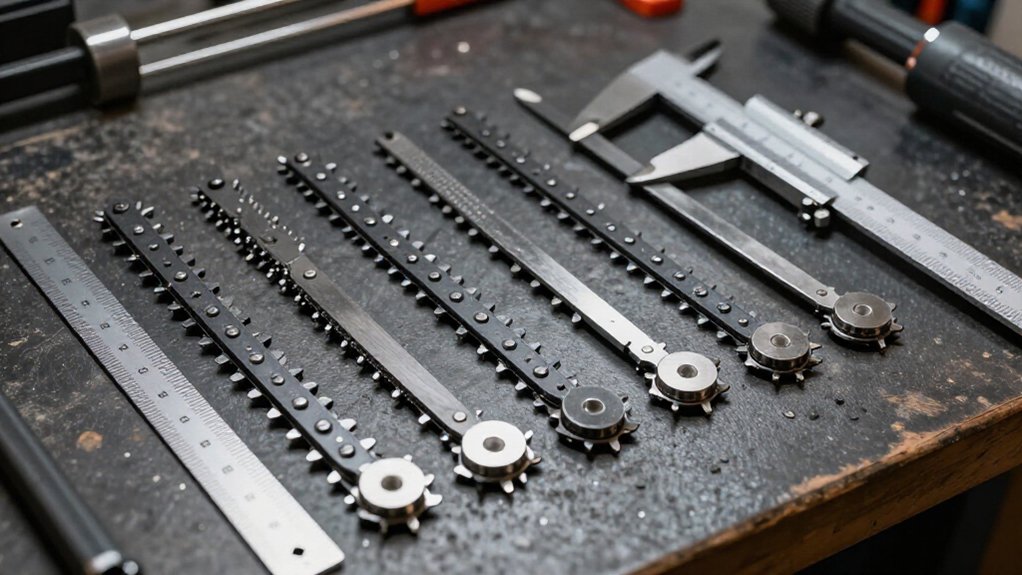
Choose your round file by matching chain pitch to the maker’s specification; pitch gives you a starting point, not a guarantee.
For 1/4-inch and 3/8-inch low-profile chains, use 4.0-mm files, though some mini chains need 3.5 mm. A .325-inch chain commonly takes 4.8 mm, while some STIHL models use 4.5 mm.
Standard 3/8-inch and .404-inch chains often take 5.5 mm; some 3/8-inch chains specify 5.2 mm.
Check markings and cutter type, then follow the maker’s angle and guide. Continue for identification and sharpening checks.
Pitch-to-File Diameter Match
Match the round-file diameter to your chain’s pitch, but confirm the exact size in your saw manual or the chain maker’s specifications.
For a 1/4-inch-pitch chain, you’ll commonly use a 4.0 mm (5/32-inch) file; some 1/4-inch mini chains call for a 3.5 mm (9/64-inch) file. A 3/8-inch low-profile chain commonly takes a 4.0 mm (5/32-inch) file. Choose a 4.8 mm (3/16-inch) file for most .325-inch-pitch chains, though some .325-inch Stihl chains specify 4.5 mm (11/64-inch).
Standard 3/8-inch and .404-inch chains commonly use 5.5 mm (7/32-inch) files; some 3/8-inch chains instead specify 5.2 mm (13/64-inch). Treat these values as starting points, not substitutes for chain-specific guidance. Check your chain’s markings and verify its pitch before buying or sharpening. Using the specified diameter helps you maintain the intended file position and cutting geometry.
Cutter Tooth Profile Differences
Cutter profile determines both how a chain cuts and how you should sharpen it. Full-chisel teeth have square-cornered edges and cut quickly, but dirt dulls them fast. Use a precise 30° to 35° top-plate angle. Semi-chisel corners are rounded, resist abrasive wood, and tolerate small filing errors; guide your round file. Round-tooth cutters have curved profiles and also take a round file.
| Profile | Cutting behavior | Sharpening |
|---|---|---|
| Full-chisel | Fast; dirt dulls quickly | Round file; 30° to 35° top-plate angle |
| Semi-chisel | Durable in abrasive wood | Round file and guide |
| Round-tooth / square-ground | Curved / square edges | Round / square filing |
Square-ground chisel cutters need square filing, not a standard round file. Match file shape and angle to the profile, and check your chain maker’s guidance because specifications can vary. Before filing, identify the cutter’s edge shape; using the wrong file can alter its geometry, reduce cutting performance, and make sharpening harder. Follow the maker’s instructions.
Pitch, Gauge, and Markings
To choose the right round file, start with the chain’s pitch: the distance across three consecutive rivets divided by two. Pitch is the main factor in selecting file diameter, but gauge helps identify the chain. Gauge measures the thickness of its drive links; common values are 0.043, 0.050, 0.058, and 0.063 inches.
Check the drive links or guide-bar markings for both measurements. A code such as 325-050-72 gives pitch, gauge, and drive-link count, respectively. If markings have worn away, measure across three consecutive rivets and divide by two to estimate pitch. Don’t infer pitch from gauge alone. Chain designs can use different file specifications, so verify the required file size for your chain in your saw manual or on the chain packaging before filing.
Manufacturer-Specific File Recommendations
Don’t choose a file by pitch alone; check your chain’s markings and the manufacturer’s chart. Husqvarna and STIHL recommendations vary by chain model, and Oregon chains also have model-specific specifications. Verify the exact chain before filing, for example, some .325-inch STIHL Pro chains require a 4.5 mm (11/64-inch) file.
Husqvarna File Recommendations
Because file size varies by chain model, check your Husqvarna manual or new-chain packaging before sharpening. Husqvarna’s listed diameter applies to the specific chain, not simply the saw or pitch, so identify the chain model first.
For 1/4-inch and 3/8-inch mini chains, including SP21G and S93G, Husqvarna commonly recommends a 4.0 mm (5/32-inch) round file. For .325-inch chains such as SP33G, S35G, and H30, use a 4.8 mm (3/16-inch) file. Many 3/8-inch and .404-inch chains, including C83, C85, S85, and H54, call for a 5.5 mm (7/32-inch) file.
Before you file, confirm the chain’s model or pitch against its markings and documentation. If either is unclear or the recommendation doesn’t match, ask a Husqvarna dealer; don’t guess at diameter. Avoid filing with any unverified file diameter.
STIHL File Recommendations
Like Husqvarna, STIHL specifies file diameter by chain model, so don’t rely on pitch alone. For a common example, STIHL .325-inch Pro chains typically take a 4.5-mm (11/64-inch) round file. STIHL 3/8-inch low-profile chains commonly call for a 4.0-mm (5/32-inch) file; standard 3/8-inch chains may require a larger diameter. That distinction matters: chains sharing a pitch category don’t necessarily share a filing specification.
Before sharpening, identify your chain using its stamped identification code, package, or STIHL manual, then confirm the listed diameter. Don’t substitute a general chart for the manufacturer’s recommendation. A correctly sized file still won’t produce the intended cutter geometry unless you also hold it at STIHL’s specified height and filing angle. Use the matching guide or filing instructions where needed. Verify.
Oregon File Recommendations
Oregon’s recommended file diameter depends on the chain model, not just its pitch: many 1/4-inch and 3/8-inch low-profile chains use a 5/32-inch (4.0 mm) file, while many .325-inch chains use a 3/16-inch (4.8 mm) file.
For standard 3/8-inch and .404-inch Oregon chains, you’ll commonly need a 7/32-inch (5.5 mm) file. Some 3/8-inch models instead specify 13/64-inch (5.2 mm), so pitch alone isn’t enough. Match your chain’s model number or packaging before sharpening. Use the specified round file with a guide, keeping about one-fifth of its diameter above the cutter’s top plate.
This position helps preserve cutter geometry as you sharpen. Apply strokes and keep the filing angle consistent across cutters for an even edge. Recheck the cutter profile periodically, and avoid removing excess material.
Check Manufacturer Charts
Check the chain manufacturer’s chart or packaging for the specified round-file diameter, since recommendations can differ between chains with the same pitch.
Use the chart for your chain’s model, not a pitch-only rule. For example, Husqvarna lists 4.8 mm (3/16 in) for many .325-pitch chains and 5.5 mm (7/32 in) for many 3/8- and .404-pitch chains. Exceptions matter: some .325-pitch Stihl chains call for an 11/64-in (4.5 mm) file. Locate the chain model or markings on its drive links, then match them to the manufacturer’s recommendation. Don’t assume another brand’s chart applies, even when pitch seems similar. If the chart doesn’t clearly identify the recommended diameter, or you can’t interpret the chain markings, ask an authorized dealer to confirm the correct file for that exact chain.
Verify Chain Specifications
To verify the right file size, match the chain’s stamped model or type code, such as Husqvarna SP33G or STIHL type 90, to the manufacturer’s chart.
Check your chainsaw manual, chain packaging, or guide-bar markings for the recommended round-file diameter. Pitch alone may not identify the correct size, because manufacturers can specify different files for chains with similar pitches.
A .325-inch chain may call for a 4.8 mm (3/16-inch) file, while a specific STIHL .325 chain may require 4.5 mm (11/64-inch). For a 3/8-inch chain, confirm the exact specification; the chart may list a 5.2 mm or 5.5 mm file.
If chain markings are unreadable or the chart is unclear, ask an authorized dealer to verify the chain code and file diameter before sharpening.
Filing Angle and Stroke
Set the file’s top-plate angle to match your chain: standard full-chisel chains commonly use 30° to 35°, while some semi-chisel chains call for 10°.
Keep the file level at the down angle your manufacturer specifies; for standard Oregon and Stihl chains, that angle is usually 0°. Check your chain’s instructions before filing, since specifications can vary. Place the round file in the cutter and guide it smoothly from the inside toward the outside. Apply even pressure on each forward stroke, then lift the file on the return stroke rather than cutting backward.
Start with about three to five strokes per cutter, adjusting to its condition while keeping your stroke count consistent across the chain. Use the same number of strokes on left- and right-hand cutters to help prevent curved cuts. Maintain your chosen top-plate angle throughout each stroke; a steady file path supports uniform cutter geometry and cutting.
Filing Damaged Cutters
Even with the correct filing angle, a damaged cutter shouldn’t be sharpened. Inspect each tooth before filing, checking for cracks, bends, or damage to its hardened surface. If you find any of these defects, replace the chain; filing can’t restore integrity or a hardened cutting edge.
If a cutter is merely dull, use the round-file diameter specified for your chain and make smooth, even strokes. Hold the file at the manufacturer’s recommended angle, and remove a consistent amount from each cutter to maintain uniform cutting. Measure cutter length from the tip to the depth-gauge shoulder. Replace the chain when any cutter wears below 4 mm (5/32 in). Don’t file cutters at or beyond this service limit: they may cut poorly and produce excessive vibration.
Out-of-Box Chain Identification
For an out-of-box chain, check the packaging or saw manual for the chain identification and recommended round-file diameter.
Then inspect pitch and gauge markings on the guide bar or drive links. A code such as “325-050-72” identifies a .325-inch pitch, a .050-inch gauge, and 72 drive links. Match the pitch and model code to the chain manufacturer’s file-size chart; similar pitches don’t always use the same file diameter. If the markings aren’t clear, give a dealer the saw, bar, and chain details for identification. Don’t select a file by appearance alone. Its diameter must suit the cutter profile, with about one-fifth of the file extending above the cutter’s top plate. Check the recommendation before filing, and confirm the file sits correctly in the cutter.
Uneven Cutter Lengths
If cutters differ in length, the chain may cut crookedly because one side removes more wood than the other. Check cutter lengths before sharpening; a mismatch can steer the bar sideways through the cut. Use the chain’s specified round-file size and angles throughout.
- Compare each cutter with the shortest cutter using a gauge for comparison.
- File longer cutters evenly until they match, keeping strokes smooth and pressure similar.
- Apply the same number of strokes to every left- and right-hand cutter; alternate sides to maintain consistency.
- Set depth gauges afterward with a depth-gauge tool, following the manufacturer’s specifications.
If cutters vary greatly in length or show damage, don’t file beyond the chain’s service limit. Have a professional assess the chain or replace it. Consistent cutter lengths help the chain track straight, while correct depth-gauge settings control bite.
Chain Replacement Warning Signs
Replace a chainsaw chain when the cutters reach their service limit or show damage: the distance from a cutter tip to the depth-gauge shoulder must be at least 4 mm (5/32 in).
Use these checks before filing or returning the saw to work:
- Measure each cutter: if the tip sits less than 4 mm (5/32 in) above its depth-gauge shoulder, replace the chain.
- Inspect links under bright light; cracks, bends, or damaged hardened surfaces from dirt or metal call for replacement.
- Watch the cut: a chain sharpened past service length may wander, cut poorly, and shake the saw excessively, even when sharp.
- Replace heavily damaged chains or cutters filed too many times; a fresh chain restores safer, more effective cutting on your next job.
Conclusion
Match your round file to the chain’s pitch, then confirm the recommendation in the manufacturer’s chart or chain markings. Check cutter profile and gauge before filing; pitch alone may not identify the correct diameter. Keep the file angle consistent, use controlled strokes, and avoid forcing a file into damaged or uneven cutters.
If cutters remain mismatched or the chain shows cracks, excessive wear, or damaged drive links, replace it. Correct sizing supports clean cutting and safer maintenance.