Chainsaw Battery Amp-Hours Explained: Ah, Voltage and Runtime
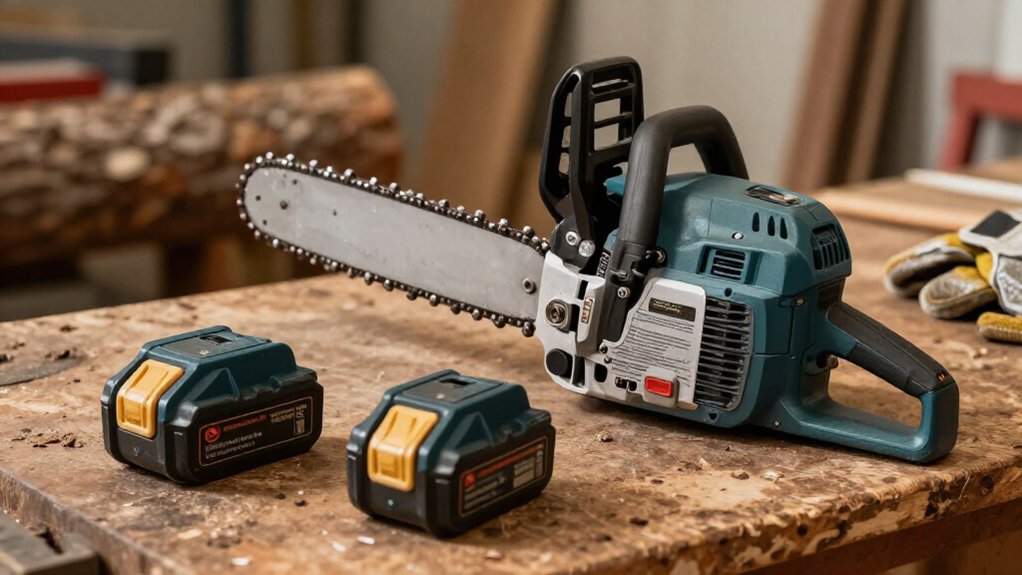
Your chainsaw’s amp-hour (Ah) rating measures battery capacity, not the current the saw draws. To estimate runtime, divide Ah by amps; a 5Ah pack supplying 10A would last 30 minutes, though cutting conditions reduce that time.
Voltage and current determine power, while watt-hours (Ah × volts) compare energy across platforms.
Match the pack’s voltage and output rating to your saw. Wood, chain condition, and battery temperature also shape runtime; the sections below explain the factors.
Chainsaw Runtime at a Glance
A chainsaw’s runtime depends on its battery capacity in amp-hours (Ah) and its average current draw: a 5Ah battery supplying a 10A load provides about 30 minutes of ideal runtime. For a quick estimate, divide the battery’s Ah rating by the saw’s current draw in amps. Your actual cutting time will usually be shorter because motor load changes during cuts, while heat and other inefficiencies reduce usable energy.
If the manufacturer lists power in watts, divide watts by battery voltage to estimate current: a 1,000W saw on a 40V battery draws about 25A. Cutting conditions matter. Harder wood, larger cuts, a dull chain, and continuous operation can increase demand and shorten runtime. Ease the workload with a sharp chain and pauses between cuts when practical.
Battery Capacity in Amp-Hours
Amp-hours (Ah) measure a battery’s charge capacity: a 5Ah battery can theoretically supply 5 amps for one hour or 2.5 amps for two hours. On the same-voltage chainsaw battery platform, a higher Ah rating generally gives you longer cutting time between charges; it doesn’t increase voltage. To estimate runtime, divide battery capacity in Ah by the saw’s average current draw in amps.
This is only an estimate, because cutting load and operating conditions change current demand. When you compare batteries with different voltages, look at watt-hours (Wh), calculated by multiplying Ah by voltage. Ah alone doesn’t show total stored energy. You also can’t assume you’ll use the full rated capacity: battery chemistry, temperature, age, discharge rate, and the saw’s load can reduce actual runtime.
Chainsaw Cut-Time Examples
To estimate chainsaw cut time, divide battery capacity by the saw’s average current draw: a 5Ah battery supplying 10A provides about 30 minutes of ideal runtime, while a 15A draw reduces that to about 20 minutes.
For a 4Ah pack drawing 8A, you’ll get roughly 30 minutes: 4Ah ÷ 8A equals 0.5 hours. At a steady 10A, a 2.5Ah battery gives about 15 minutes, whereas a 5Ah battery gives about 30. These figures describe continuous cutting under ideal conditions, not a guaranteed session length.
Your actual cut time can shift with wood type, cutting intensity, battery condition, and pauses between cuts. Tougher wood or heavier cutting can raise current demand, shortening runtime; lighter work may extend it. Use the calculation as a comparison tool: match the battery’s amp-hour rating to the saw’s average draw, then treat the result as an estimate rather than a precise prediction. That helps you compare setups before choosing a work plan for your typical cuts.
Cell Layout Options
Cell Layout Options
You raise pack voltage by connecting cells in series; five nominal 3.6V cells, for example, form an 18V pack often marketed as 20V Max. You increase amp-hours by connecting cells in parallel, which adds capacity without changing voltage. A series-parallel layout combines both effects: a 5S2P pack delivers roughly twice the amp-hours of a 5S1P pack.
Series Cell Groups
Although a chainsaw battery’s cell layout can vary, cells in series add their voltages while keeping the group’s amp-hour capacity unchanged. This arrangement raises the pack’s nominal voltage without increasing how much charge the series group can deliver.
For example, connect five lithium-ion cells, each rated at 3.6 volts and 2 amp-hours, in series: you get an 18-volt, 2-amp-hour group. The voltages add (5 × 3.6), but the capacity remains 2 amp-hours, not 10. So, when you assess a chainsaw battery, don’t treat a higher voltage as evidence of higher Ah capacity. Check both ratings: voltage indicates the electrical potential supplied to the saw, while amp-hours describe the group’s charge capacity. The label helps you identify the electrical arrangement, not the group’s amp-hour rating.
Parallel Cell Groups
Where series-connected cells raise voltage, parallel-connected cells keep voltage unchanged while adding their amp-hour capacities.
When you connect cells in parallel, you join their positive terminals and their negative terminals. The group’s voltage matches one cell’s voltage, but its capacity equals the sum of the cells’ amp-hour ratings. For example, two 3.6V, 2.5Ah cells create a 3.6V, 5Ah group.
This added capacity can extend runtime, while parallel cells can also share the current your saw demands. The actual runtime still depends on cutting load, battery condition, and operating conditions, so don’t treat the Ah rating as a guaranteed duration. When comparing replacement batteries, check both voltage and amp-hours against your chainsaw’s requirements. Voltage must also suit the tool, and the cell layout determines both ratings.
Series-Parallel Configurations
Series-parallel layouts combine cells in series to raise voltage and in parallel to increase amp-hour capacity. A series string adds cell voltages, while its amp-hour rating stays the same: five 3.6-volt, 2-Ah cells form an 18-volt, 2-Ah pack. Parallel groups work differently: three 3.6-volt, 2-Ah cells provide 3.6 volts and 6 Ah.
A 5S2P arrangement uses ten cells; it delivers five times one cell’s voltage and twice its Ah capacity. The same cells arranged as 10S1P produce higher voltage and lower Ah than 5S2P, but total watt-hours remain approximately equal.
For your chainsaw, check the pack’s nominal voltage and capacity against the saw’s specifications; matching both helps confirm compatibility. Don’t assume equal cell counts mean equivalent packs: layout changes voltage and Ah, not packaging.
Bar-and-Chain Load
Your bar-and-chain load rises when you force the saw through dense or wet wood, increasing current draw and reducing runtime. A sharp, correctly tensioned chain cuts with less resistance than a dull or overly tight one. Because large or hardwood logs require more energy per cut, your battery’s amp-hour rating alone can’t predict total cuts.
Cutting Resistance
When the chain meets dense, hard, frozen, or knotty wood, cutting resistance rises and the motor draws more current, draining the battery faster.
A longer bar can keep more chain in contact with wood, increasing load, particularly when you bury the bar in a cut. Forcing the saw or pinching the bar can sharply raise current draw, slow the motor, or trigger battery protection. Keep the chain moving at its recommended speed; let the saw advance at its own pace to limit unnecessary drain overall.
| Condition | Load effect | Battery response |
|---|---|---|
| Dense wood | Higher resistance | Faster drain |
| Buried bar | More contact | Higher draw |
| Forced cut | Motor slows | Protection may trip |
| Free cutting | Controlled load | Longer runtime |
Chain Sharpness
A sharp chain cuts efficiently, so the motor draws less current and the battery generally lasts longer per charge.
When your chain dulls, its cutters create more friction and cutting resistance. The motor must work harder, increasing electrical load and shortening runtime. A pinched bar or sawdust packed into the chain path can add resistance too, draining the battery faster even when the chain’s cutters remain sharp.
Keep the chain properly sharpened and tensioned, and clear debris from the bar groove before cutting. If runtime drops unexpectedly, inspect the chain and bar before assuming the battery has lost capacity. A well-maintained bar-and-chain assembly lets you use stored energy more effectively, though actual runtime still depends on operating conditions and cutting technique in actual use.
Wood Density
Wood Density
Even with a sharp, properly tensioned chain, wood type and log size affect battery load.
Denser hardwoods such as oak and hickory resist cutting more than softer pine. Your saw must remove material against greater resistance, which raises current draw and reduces runtime from the same battery. A larger-diameter log keeps more of the bar and chain engaged, increasing load compared with a branch of that wood.
Keep your chain sharp and tensioned; a dull or overtight chain adds resistance, drains the pack faster, and can heat the motor and battery. Don’t force a cut or let the bar bind in the kerf: let the chain cut at its own pace.
Because cutting conditions change current draw, your battery’s amp-hours alone can’t predict runtime. The same pack may make fewer cuts in thick hardwood than in softwood branches.
Battery Pack Voltage Choices
Chainsaw battery voltage determines how much electrical power the pack can deliver at a given current, since watts equal volts multiplied by amps. Most chainsaws use packs rated around 18V, 36V, or 40V, but you must match the voltage specified for your saw. A higher-voltage pack can supply more power at the same current; it doesn’t automatically provide more stored energy.
Manufacturers create voltage by connecting cells in series. For example, five lithium-ion cells rated at 3.6V each form an 18V nominal pack. Labels can differ: “36V” usually states nominal voltage, while “40V Max” describes the fully charged voltage of a similar pack class. When you compare packs with different voltages, look beyond amp-hours. Calculate watt-hours by multiplying volts by amp-hours; that figure lets you compare their energy capacity.
Thermal Shutdown in Cold Weather
Cold weather can reduce a lithium-ion battery’s usable capacity by roughly 20 to 30% around 32°F (0°C), shortening runtime below what its amp-hour rating suggests.
In weather, lithium-ion cells operate less efficiently. Under a chainsaw’s cutting load, battery voltage can sag enough to trigger the pack’s protection system and stop the saw. That shutdown doesn’t mean the battery has failed; capacity loss or repeated overloads may be responsible. If your saw stops, pause and check the battery’s temperature and charge level before restarting. Let a pack warm gradually to the manufacturer’s operating temperature before use or charging. Don’t use an open flame or direct high heat. Keep spare batteries insulated and warm, and follow your saw and battery manuals for operating and charging temperature limits.
Confusing Amp-Hours With Amps
Amps measure the current a chainsaw draws at a given moment, while amp-hours (Ah) measure a battery’s capacity over time. Don’t treat the ratings as interchangeable: Ah describes stored charge, whereas A describes instantaneous demand. Use these checks:
- A 5Ah pack could theoretically deliver 5A for one hour or 10A for half an hour.
- Your chainsaw’s changing load and usable capacity determine actual runtime.
- A higher Ah rating generally extends cutting time between charges; it doesn’t raise output current or chainsaw power.
- Compare maximum output ratings too: a high-capacity pack may not supply the current a demanding saw needs.
At equal voltage, a 4Ah battery stores about twice the capacity of a compatible 2Ah battery, but both retain the same nominal voltage. Check compatibility.
Match Ah to Cutting Tasks
Once you’ve confirmed a battery can supply your saw’s required output, choose its capacity around the work you’ll do. For light pruning and occasional small cuts, 2.0–3.0Ah keeps your saw lighter and easier to handle. Choose 4.0–5.0Ah for longer sessions or thicker branches when fewer swaps outweigh added weight. For sustained, demanding work, 6.0Ah or higher extends runtime, though the extra mass can increase fatigue.
| Task | Capacity | Trade-off |
|---|---|---|
| Light pruning | 2.0–3.0Ah | Lower weight |
| Longer or heavier cuts | 4.0–5.0Ah | Fewer swaps |
At the same voltage, 4.0Ah stores about twice the charge of 2.0Ah; runtime still varies with wood hardness, cutting load, and technique. Higher Ah adds runtime, not voltage, so match your battery to the saw’s voltage platform and verify its output rating before you begin cutting.
Conclusion
To estimate chainsaw runtime, start with watt-hours, voltage multiplied by amp-hours, then account for cutting load, chain condition, wood, and temperature. Higher Ah gives you longer runtime, while voltage influences power; neither number predicts cut time. Choose a pack that matches your saw and task, and keep a spare for extended work.
Don’t confuse amp-hours with amps: capacity describes stored energy, while current reflects demand. In cold conditions, warm the battery and expect protection limits.
Battery Chainsaw Runtime Estimator
Estimate battery chainsaw runtime from battery voltage, amp-hours, rated watts and duty cycle, with an optional corded-saw energy comparison.
Battery vs Gas Chainsaw Cost-of-Ownership Calculator
Compare the total cost of a gas and a battery chainsaw over the years with your own fuel, power and usage numbers, and find the break-even point.