Chainsaw Bar Length Chart: The Right Size for Every Tree and Job
Chainsaw Bar Length Chart: The Right Size for Every Tree and Job
Choose a bar at least 2 inches longer than the trunk diameter for a straight-through cut, but first confirm your saw approves its length, mount, pitch, and gauge.
Trees under 14 inches commonly suit 16 to 18-inch bars; 14 to 16-inch trunks need 18 inches, while 16 to 18-inch trunks need 20 inches. Measure where you’ll cut; angled cuts may span farther.
Dense hardwood and knots increase load. Keep every cut below shoulder height. Continue for key sizing and safety checks.
Recommended Bar-to-Tree Ratios
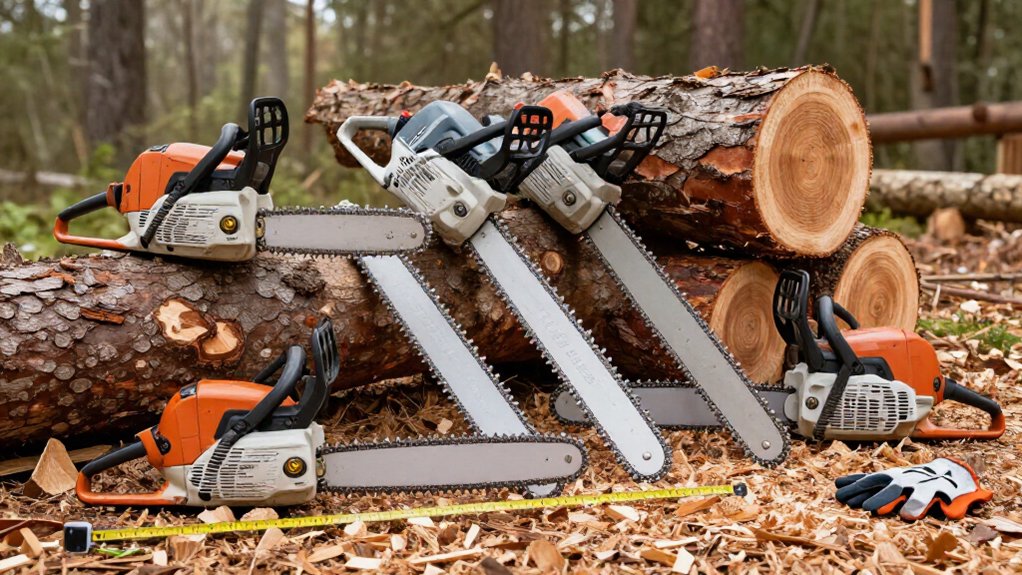
For a straight-through cut, choose a chainsaw bar at least 2 inches longer than the tree’s diameter: a 16-inch bar suits trees under about 14 inches wide, an 18-inch bar suits trees around 14 to 16 inches, and a 20-inch bar typically suits trees around 16 to 18 inches.
Use these ratios as starting points, not guarantees. Before cutting, check your saw’s manual: the engine must support the selected bar, and the model’s approved bar range sets the limit. A bar that’s too long can reduce cutting performance and control; never fit one outside that range.
Measure the trunk at the intended cut and account for uneven shape or bark. If the trunk exceeds the bar’s reach, a cut from opposite sides may be possible, but only with proper technique and experience. Keep the chain sharp, maintain a stable stance, and follow established felling procedures. If you’re unsure about the saw’s capacity or the cut, stop and consult a qualified professional. Don’t attempt unfamiliar cuts; maintain escape routes and keep all bystanders well clear.
Bar Length by Tree Diameter
Choose a bar at least 2 inches longer than the tree’s diameter for a one-pass cut, if your saw’s manual lists that length as compatible. For trees under 14 inches in diameter, a 16 to 18-inch bar is commonly suitable. An 18-inch bar suits trees about 14 to 16 inches across; a 20-inch bar fits trees about 16 to 18 inches across.
| Diameter | Suggested bar |
|---|---|
| Under 14 in | 16 to 18 in |
| 14 to 18 in | 18 to 20 in |
Trees over 18 inches may require a bar longer than 20 inches, but only if your saw has power and the manual approves it. A bar supports control; an oversized setup can strain the saw and raise handling risks. Never force a one-pass cut if the trunk or equipment makes it unsafe. Check your manual, use sound technique, and wear protective gear.
Nominal vs. Usable Length
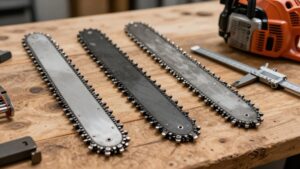
Although a bar may be labeled 16 or 20 inches, its nominal length differs from its usable cutting length, the approximate distance from the saw body to the bar tip.
To check usable length, lay the bar flat and measure from where it exits the chainsaw body to its tip. This measurement identifies the bar’s nominal size; round the result up to the nearest standard increment, since bars come in set lengths. If measuring is difficult, read the stamped or embossed length near the bar’s attachment point to confirm its nominal size.
Don’t treat usable length as proof of fit: it doesn’t establish compatibility with your saw. Before installing or replacing a bar, consult the owner’s manual and use only approved lengths. Keep the saw switched off while measuring, and don’t adjust cutting equipment with the engine running.
Wood-Specific Cutting Considerations
When choosing a bar, account for species, grain, moisture, and knots: dense hardwoods such as oak and maple demand more power than pine or spruce. Match bar length to wood diameter: 16 to 18 inches suits many 4 to 12-inch firewood logs, while larger rounds may need a longer bar or multiple cuts. Use only a manufacturer-approved bar length, and don’t fit a longer bar unless your saw has sufficient power.
Hardwood Versus Softwood
Because dense hardwoods such as oak and maple demand more power than pine or spruce, match the bar to the wood’s diameter and your saw’s manual-approved range. A longer bar can reach through wider logs, but your saw must have enough power to drive it effectively. Don’t fit an unnecessarily long bar for hardwood: added engine load can slow cutting and make the saw harder to control.
For occasional firewood, a 16–18-inch bar suits many typical logs. Larger hardwood rounds may call for a more powerful saw and a compatible longer bar; check the manual before fitting one. Keep your chain sharp and the bar properly lubricated when cutting dense wood. These steps support smooth cutting and help limit excess heat. Don’t exceed the saw’s approved setup to gain reach.
Grain and Density
Wood grain and density affect how a chainsaw cuts, even with the same bar length.
Dense hardwoods such as oak and maple demand more cutting power than pine or spruce. With a fixed bar length, you’ll usually cut hardwood more slowly and put greater load on the saw. Choose a bar the engine can drive effectively, sized to the wood’s diameter; an unnecessarily long bar can bog the saw and strain the engine. Check your model’s manual for its approved bar-length range before fitting a different bar. Don’t assume that a longer bar improves reach without tradeoffs: adequate power and control matter throughout the cut.
Keep your chain sharp and your bar properly lubricated to support smooth cutting in either wood type. Maintain control.
Wet Versus Dry Wood
Wet wood is heavier and can be harder to handle, so don’t choose a longer bar just to increase reach. Choose a bar you can control safely, matching its length to your saw’s power and the wood’s diameter. Dense hardwood such as oak or maple demands more cutting power than pine or spruce, especially when it’s wet. An overly long bar can bog the saw and strain its engine.
For wet or dry firewood, a 16 to 18-inch bar suits many typical homeowner jobs. Larger rounds may require a 20-inch bar, but use one only if your saw’s manual permits it. Don’t exceed the manufacturer’s limits or force a cut the saw can’t handle. Keep your chain sharp and the bar properly lubricated in either condition.
Knotty Wood Challenges
When knots make a cut uneven, the chain can meet changing resistance and strain the saw. Keep your chain sharp so it cuts, and select a bar length your saw can power comfortably. Match the bar to the log’s diameter and stay within the range approved in your owner’s manual.
A longer bar increases engine demand and can make the saw harder to control, especially as the chain encounters knots. For knotty firewood, a 16–18-inch bar suits logs; use a longer bar for thicker rounds only when your saw supports it. During repeated cuts, avoid excess bar length to limit fatigue and preserve control. Let the chain do the work; don’t force the saw through resistant wood, and pause if cutting performance drops.
Species-Specific Bar Choices
Species affects how much cutting power your saw needs: dense oak and maple demand more than pine or spruce, so a shorter bar may be easier to manage in hardwood, while a longer bar can cut larger softwood logs in one pass if your saw can drive it.
Match bar length to the trunk’s diameter and your saw’s power; never exceed its recommended range. For firewood, a 16–18-inch bar handles many 4–12-inch logs, while larger rounds may require a 20-inch bar on a sufficiently powerful saw. Before cutting, check your owner’s manual for compatible bar length, chain pitch, and gauge. Dense wood can slow the chain and increase strain, so keep the chain sharp, use steady feed pressure, and stop if the saw bogs.
Account for Angled Cuts
Because an angled cut crosses the trunk diagonally, it may require more bar reach than a straight cut. Estimate the needed reach at your intended cutting angle by measuring the longest distance across the trunk along that path; don’t rely on its upright diameter alone. For example, a 16-inch trunk may need a bar longer than 16 inches to cross in one pass.
If your bar can’t span that distance, plan a controlled cut from more than one side rather than forcing it through. Select only a bar length approved for your saw’s model, and verify the engine or motor has enough power to manage the added reach. A longer bar changes handling and can increase kickback risk if you force it through angled wood.
No Above-Shoulder Cutting
A longer bar may help with an angled cut, but it doesn’t make overhead work safe. Keep every chainsaw cut below shoulder height; reaching above it reduces your control and increases injury risk. Don’t use extra bar length to reach overhead branches. Choose a safer ground-level method or hire a trained professional.
For pruning and limbing, a 10 to 14-inch bar is generally more maneuverable, but that shorter size doesn’t make above-shoulder cutting acceptable. Before you cut, establish secure footing and grip the saw with both hands. Keep the bar and chain clear of your head and body throughout the cut. If you can’t reach a branch while keeping the saw below shoulder height, stop. Use appropriate professional equipment or get qualified assistance for that task.
Storm-Damaged Limb Removal
When removing storm-damaged limbs, a 12 to 14-inch bar is generally easier to maneuver than a longer one, but use only a length approved for your saw’s power. Check the limb’s diameter against the bar’s usable cutting length; never force a cut the saw can’t complete safely in one pass. Storm-broken branches may remain under tension or trapped against other wood. Before cutting, assess how the limb could shift, roll, or spring free, and keep yourself out of its likely path.
If a limb is large, unstable, or difficult to access, stop and call trained help. Before starting, inspect the chain and bar, and confirm the bar groove is clear and lubricated. Choose stable footing, maintain a secure grip, and follow your saw’s operating instructions throughout the job, as directed.
Incorrect Chain Tension Diagnosis
How can you tell if a chainsaw chain is incorrectly tensioned? Inspect it cold, with the saw switched off and the chain brake released. Then assess its fit and movement.
- A chain that sags below the guide bar or hangs away from its rails is too loose; it may derail during cutting.
- If you can’t pull the chain around the bar by hand without difficulty, or it binds instead of moving smoothly, it’s likely too tight.
- Correct tension keeps the chain snug against the bar rails while allowing free hand movement. Follow your saw’s manual for its model-specific adjustment procedure.
Recheck tension after fitting a new chain and periodically during work: new chains stretch, and cutting heat can alter tension. Check again as needed for safety.
Confirm Bar Mount Compatibility
Before choosing a replacement bar, check your owner’s manual or the manufacturer’s website for the lengths approved for your saw model.
A bar that attaches to the powerhead may still be incompatible. Confirm these details before installation:
- Match the bar mount to your saw’s powerhead; physical fit alone doesn’t establish compatibility.
- Verify the replacement bar’s chain pitch and gauge match your saw and chain specifications.
- Contact the manufacturer to confirm the permitted minimum and maximum bar lengths for your specific model.
Don’t assume a shorter or longer bar is safe because it differs from the original. Either choice can damage your saw if it falls outside the approved range. Use only a bar configuration the manufacturer approves, and resolve any uncertainty before any cutting starts.
Conclusion
Choose a bar that matches the tree’s diameter, wood, and cutting angle, and remember that usable bar length is shorter than its nominal rating. Confirm the bar mount and chain fit before you begin. Keep cuts below shoulder height, and use approved methods for storm-damaged limbs rather than cutting under tension.
If chain tension seems wrong, diagnose it before operating. When a job exceeds your saw’s capacity or skill, stop and hire a qualified professional. Prioritize control over reach.