
Types of Tree Felling Notches: Open-Face, Conventional and Humboldt
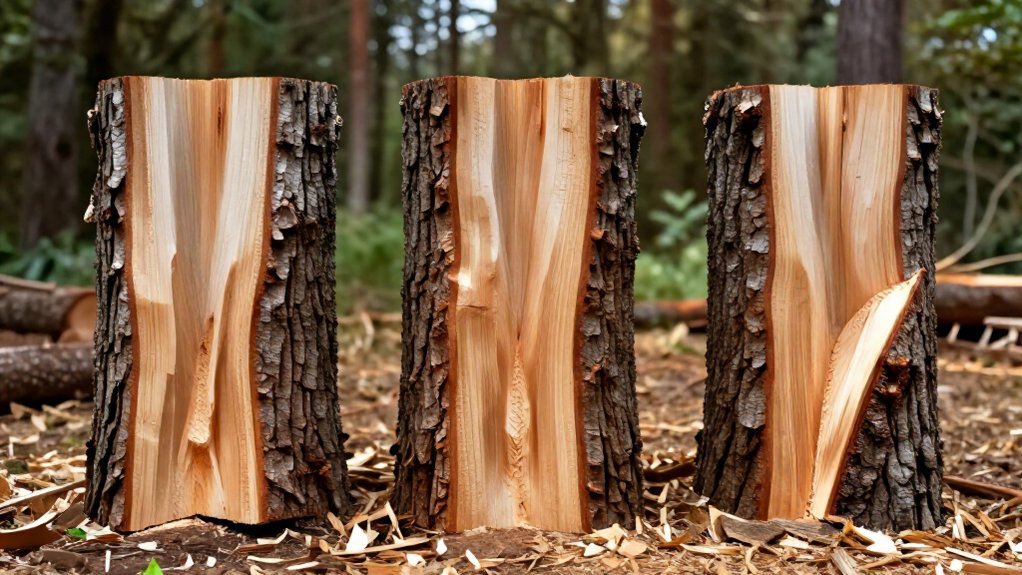
Types of Tree Felling Notches: Open-Face, Conventional and Humboldt
You identify a felling notch by its face cuts, the top and bottom cuts on the intended fall side. A conventional notch pairs a roughly 45-degree sloping top cut with a level bottom cut; Humboldt reverses them.
An open-face notch uses a wider opening, often with steeper top and angled bottom cuts.
Each relies on a continuous hinge, but geometry cannot guarantee direction. Further guidance explains hinge limits, terrain effects, and when qualified help matters most.
Notch Type Identification
Identify a tree-felling notch by the orientation and angle of its two face cuts, not by the back cut: a conventional notch has a sloping top cut and level bottom cut, while a Humboldt notch reverses that arrangement.
An open-face notch presents a wide opening, commonly made with a steep top cut and an angled bottom cut. Confirm that the two face cuts meet at the apex; if they miss, the misalignment may create a Dutchman. Don’t classify the notch from the back cut, which doesn’t define its type. Inspect the cut surfaces and verify their orientation before continuing.
If you can’t identify a clean, aligned notch, stop work and reassess the felling plan with a professional. Keep yourself and others outside the hazard area.
Notch Cut Angles
Once you’ve identified the notch type, check its angles: a conventional notch typically has a 45-degree top cut, while an open-face notch often pairs a top cut near 70 degrees with a bottom cut near 30 degrees. The conventional bottom cut meets the top at the apex. A Humboldt notch reverses that arrangement; make its cuts meet at the apex, forming an opening of at least 45 degrees.
Angles around 70 to 90°+ can help keep the notch engaged through much of the fall arc, but no angle guarantees control. Lean, species, tree structure, and site slope affect the fall. Assess conditions, use an equipped crew, and stop for expert help if the setup is uncertain.
| Angle | Safety cue |
|---|---|
| 70 to 90°+ | Longer engagement |
| Site-specific | Uncertain fall |
Hinge Wood Fibers
The hinge is the uncut strip between the notch apex and back cut; its fibers guide the tree as they stretch and compress. Keep the hinge level and even, typically about 5 to 10% of the tree’s diameter, and account for grain direction when evaluating its strength. Your notch choice affects how long the fibers guide the fall: a wider opening can preserve their effect longer, while an open-face notch may keep them intact after ground contact.
Hinge Fiber Function
As the tree begins to fall, the uncut strip of wood between the notch apex and the back cut, the hinge, guides its movement. You rely on this connection to guide the tree toward its intended lay, but it can’t replace planning or escape routes. Keep the hinge even in thickness and level across the cut.
A well-proportioned hinge measures five to ten percent of the tree’s diameter, though dimensions alone can’t guarantee a predictable fall. An open face of seventy to ninety degrees or more can preserve guidance through much of fall. Conventional and Humboldt notches lose guidance when their narrower openings close and the tree breaks away from the stump. Assess species, wood quality, lean, slope, and structure when judging hinge behavior.
Fiber Stretch and Compression
When the tree starts to fall, its hinge fibers bend: fibers on one side stretch while those on the opposite side compress, helping guide the tree’s movement. Treat this bending as a limited, controlled guide, not a guarantee of direction. You must make the notch and back cut accurately, then keep clear of the fall zone and escape route.
An open-face notch leaves a wider opening, so the hinge can continue guiding the tree through a greater arc, often about 70 to 90 degrees, before the notch closes. With conventional or Humboldt notches, the smaller opening closes sooner; the hinge then stops guiding as its fibers break. Don’t assume the hinge will hold if the tree encounters wind, defects, or unexpected loading. Assess the tree and surroundings before cutting, and follow safe felling procedures. If conditions exceed your training or equipment, stop and get qualified help. Wear protective equipment and communicate with your team.
Hinge Thickness and Width
A hinge of uniform wood fibers guides the tree as it falls; its thickness, set by the back cut, is commonly about 5 to 10% of the tree’s diameter. Treat this strip, the uncut wood between the notch apex and back cut, as a guide, not a guarantee. Keep its width and thickness level across the stem; uneven hinge wood can guide the fall inconsistently.
Your back cut determines remaining thickness, so control its position and levelness; don’t cut through the hinge. Match notch design to guidance: a wide open-face notch can preserve the hinge longer through the fall arc. Assess the tree, lean, surroundings, and escape route; use equipment and established procedures. If defects or conditions prevent a sound, even hinge, stop and consult a qualified professional.
Grain Direction Matters
Grain direction matters because the hinge’s continuous fibers guide the tree as it falls. The hinge is the uncut strip between the notch apex and back cut. You need to preserve its fibers across the stem: severed fibers or uneven thickness can reduce directional control and make the tree move unpredictably.
Before cutting, assess the trunk’s structure, grain direction, and wood quality. Irregular grain, defects, or changes in fiber alignment can cause one side of the hinge to hold more strongly than the other. Keep the hinge continuous and evenly thick, generally about 5 to 10% of the tree’s diameter, then adjust that dimension for wood strength and site conditions. Don’t rely on measurement alone; if the hinge won’t hold uniformly, stop and reassess the felling plan.
Notch Choice and Fiber Behavior
Notch geometry affects how long the hinge fibers can guide the tree. The hinge is the uncut strip between the notch apex and back cut; its fibers steer the tree during descent. Aim for thickness around 5 to 10% of the tree’s diameter, keeping it as even and level as possible.
A wide open-faced notch, typically 70 to 90° or more, lets those fibers remain engaged through more of the fall arc. Conventional and Humboldt notches close sooner, so their hinges may stop guiding the tree earlier. Don’t assume geometry alone determines control: lean, slope, species, wood quality, and tree structure change fiber behavior and hinge performance. Assess these factors before choosing a notch, and use judgment throughout the operation.
Back Cut Placement
To preserve the hinge fibers that guide the tree’s fall, place the back cut level with the open-face notch apex; with conventional or Humboldt notches, start it typically 1 to 2 inches above the notch.
Leave a continuous, even strip of uncut wood between the notch apex and back cut to form the hinge. Keep this hinge level and uniform across the stem so its fibers guide the fall consistently. As a general guide, make hinge thickness about 5 to 10% of the tree’s diameter, then adjust for the tree and site conditions.
Use a controlled cutting sequence and check the hinge line as you work. Maintain the intended geometry around the stem, and confirm that the back cut remains aligned with your notch choice before completing the cut.
Fiber Tear-Out Risks
As the tree falls, a closing notch can sever hinge fibers before the fall is complete, reducing directional control. An open-face notch typically provides a wider opening, often about 70 to 90 degrees or more, so its faces may remain apart through more of the fall. By contrast, conventional and Humboldt notches have narrower faces; as those faces close, their guiding effect declines and hinge fibers face greater risk of failure.
Your assessment must also account for tree lean, slope, species, and wood quality, which alter the fall arc and hinge response. Notch geometry alone can’t eliminate tear-out risk. Inspect conditions before cutting, and keep people clear of the expected fall zone; fiber failure can redirect the stem abruptly without warning and beyond the intended path.
Preserving Hinge Control
Controlling fiber tear-out starts with preserving the hinge—the uncut strip between the notch apex and back cut that guides the tree as it falls. Keep this wood intact and consistent: hinge fibers provide directional control, but uneven thickness or damage can weaken that guidance. A hinge commonly measures about 5–10% of the tree’s diameter; make it as uniform and level as conditions allow.
Your notch affects how long the hinge works. An open-face notch, with an opening of roughly 70 degrees or more, can keep the hinge engaged through more of the fall arc. Conventional and Humboldt notches have narrower openings, which close sooner and can break the hinge, reducing control. Account for lean, slope, species, and wood condition when selecting notch angle and hinge dimensions. Stop if conditions make a controlled fall uncertain.
Undercut Versus Face Cut
You make the face cut with a top cut and an undercut on the side facing the intended fall direction. Place the undercut to meet the top cut precisely at the apex; for a Humboldt notch, start it below the top cut and angle it upward to create an opening of at least 45 degrees. Match the cuts to the notch type, since a gap at the apex creates a hazardous Dutchman notch and can disrupt the tree’s fall.
Undercut and Face Cut
Although often called the undercut, the face cut forms the notch on the side of the tree facing the intended fall. You make this notch with two kerfs: a top cut and a bottom cut. They should meet precisely at the apex; if they don’t, you leave a dangerous mismatch called a Dutchman.
For a Humboldt notch, you angle the bottom cut upward about 45° toward the top cut’s endpoint, creating an opening of at least 45°. Verify the cuts meet cleanly; a Dutchman can disrupt the notch’s intended geometry and compromise control.
A wider face-cut opening, such as the 70 to 90° open-face notch, lets the hinge remain engaged longer as the tree falls. You must still assess hazards and maintain a clear escape route.
Cut Placement
Place the face cut and undercut on the side facing the intended fall, aligning their endpoints at the notch apex. This placement directs the notch toward your planned lay and keeps the cuts working as one controlled opening. For a Humboldt notch, make the top cut first, then raise the undercut until it meets the top cut’s endpoint.
Check the meeting point from a stable position before proceeding; don’t let either cut cross or bypass the apex. A short undercut leaves a gap called a Dutchman, which OSHA identifies as an incorrect cut. Aligning both cuts lets the notch close cleanly as the tree moves.
Open-face notches use a wider opening, while conventional and Humboldt notches are narrower. Stay clear; follow your felling plan.
Notch Depth and Angles
Notch depth and angle determine how the face cut opens and how long the hinge can guide the tree’s fall. Set the notch depth near one-third of the tree’s diameter, adjusting for size, species, and the hinge action you need. In a conventional notch, make the top cut about 45 degrees and bring the bottom cut precisely to its apex.
An open face uses an angle of about 70 degrees or wider, allowing the hinge to guide the tree through its fall. For a Humboldt notch, start the undercut below the top cut and rise at about 45 degrees to meet its endpoint, forming an opening of at least 45 degrees. If you stop short of the face cut’s endpoint, you’ll leave a Dutchman gap. Check alignment to protect hinge integrity.
Matching Cuts to Notch Types
Because each notch type pairs its cuts differently, identify the layout before cutting and keep both kerfs aligned to meet cleanly at the apex.
For a conventional notch, make the angled top cut first; then align the bottom cut with its endpoint without crossing the apex. In a Humboldt notch, reverse that arrangement: start the undercut below the top cut and raise it at about 45° to meet its endpoint. The open-face notch uses a steep top cut, roughly 70°, and a bottom cut near 30°, creating a wide opening.
Work from a stable position. Don’t force the cuts together or let either pass the apex. If the undercut stops short of the face cut’s endpoint, you create a Dutchman notch, a mismatch that can compromise control.
Felling Leaning Trees
Before selecting a notch for a leaning tree, assess its lean, height, canopy shape, species, and the slope, since each affects its fall arc.
A wide-opening open-face notch, typically about 70–90 degrees, can let the hinge guide the tree through more of its fall. Align both notch cuts precisely at their apex; a mismatch creates a dangerous Dutchman notch and can weaken directional control. Make your back cut level and leave a uniform hinge, generally about 5 to 10 percent of the tree’s diameter, to help guide the fall.
Leaning trees can fall or split unpredictably. Keep people clear of the work area and use a safe retreat route. If the lean makes control uncertain, don’t fell the tree yourself; get help from a qualified arborist.
Power-Line Clearance
Power-line clearance requires qualified line-clearance professionals; no notch can make felling near energized conductors safe. Before you select a notch or fall direction, have qualified professionals assess the tree’s lean, height, canopy, slope, and distance from energized conductors. An open-face notch, typically opened to 70 to 90 degrees, can help preserve hinge control through more of the fall arc; however, it doesn’t guarantee clearance.
Keep workers and equipment outside the fall zone, and never allow a tree or tool to contact a power line. If contact occurs, treat the tree and equipment as energized. Stay clear; call the utility or emergency services. Don’t attempt to move or retrieve equipment until the utility confirms the line is de-energized. Maintain clearance throughout planning and work, and stop if conditions change.
Humboldt Notch on Slopes
On a slope, aim the Humboldt notch toward the intended fall direction and account for how the terrain may change the tree’s fall arc. Because this notch reverses the conventional profile, you make its lower face beneath the upper cut. Plan the cut geometry before felling; terrain can affect clearance, footing, and the tree’s movement.
- Make the undercut rise at about 45 degrees until it meets the first cut’s endpoint, creating an opening of at least 45 degrees.
- Confirm both cuts meet precisely; if they miss at their endpoints, you create a Dutchman notch that can compromise control.
- Place the back cut about 1–2 inches above the notch’s top cut.
- Don’t assume this offset prevents bounce or spring; assess hazards and use felling procedures.
Conclusion
Choose an open-face, conventional, or Humboldt notch based on the tree’s lean, site conditions, and required fall direction. Make the notch cuts meet cleanly, preserve adequate hinge wood, and align the undercut with the back cut. Treat leaning trees, slopes, and power-line corridors as elevated hazards; don’t fell near energized lines without qualified utility support.
If you can’t control the fall or verify a safe escape route, stop and bring in a certified arborist. Safety depends on sound assessment, precise cuts, and clear planning.