
2-Stroke Fuel to Oil Ratio Chart: 50:1, 40:1 and 32:1 Mix Amounts
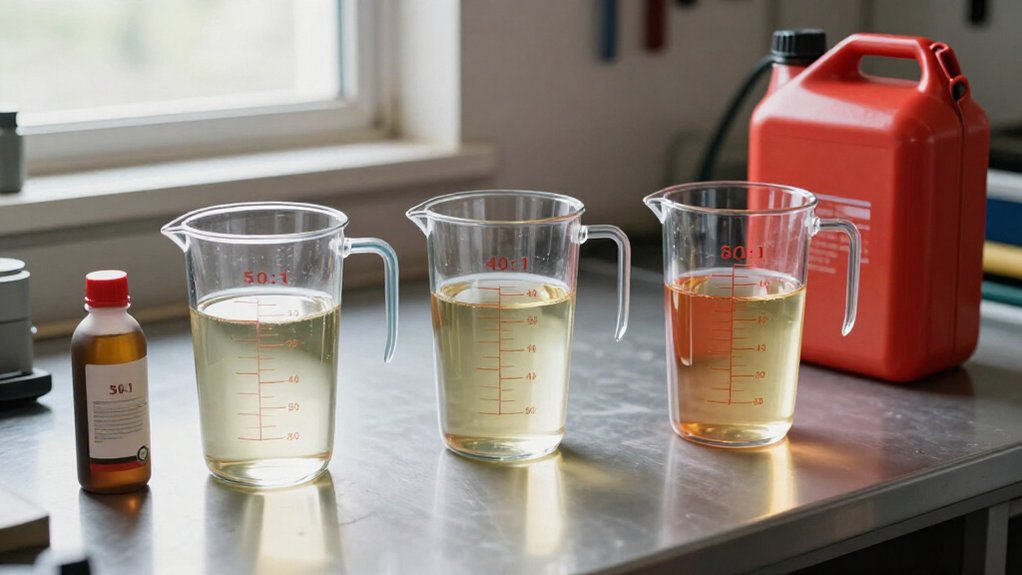
To mix two-stroke fuel, first check your equipment’s manual; use its specified ratio, not another machine’s. Per US gallon of gasoline, add 2.6 fl oz oil at 50:1, 3.2 fl oz at 40:1, or 4 fl oz at 32:1. These equal about 15.6, 19.2, and 24 teaspoons.
Measure with a graduated cup or syringe, then combine and mix thoroughly. Use two-stroke oil only. You’ll also find metric amounts, measuring guidance, and fuel-storage tips below here.
Oil Needed Per Gallon
For one US gallon of gasoline, add 2.6 fluid ounces of oil at 50:1, 3.2 ounces at 40:1, or 4 ounces at 32:1. You should use these quantities only when they match your engine’s specified ratio. Check the equipment manual before preparing fuel because oil requirements vary among engines.
Measure oil with a graduated container designed for small volumes; don’t estimate by eye or use an unmarked household cup. Accurate measurement helps you avoid too little lubrication or excess oil that can affect operation. Pour the measured oil into the gasoline container, then mix thoroughly according to the manufacturer’s instructions. Keep the container level while measuring, and read markings at eye level so you don’t misread the amount before you pour it into fuel.
50:1, 40:1, 32:1 Mix Amounts
Three common two-stroke ratios require different oil amounts per gallon: use 2.6 fl oz at 50:1, 3.2 fl oz at 40:1, or 4 fl oz at 32:1.
| Ratio | Oil per gallon | Oil per 5 gallons |
|---|---|---|
| 50:1 | 2.6 fl oz | 12.8 fl oz |
| 40:1 | 3.2 fl oz | 16 fl oz |
| 32:1 | 4 fl oz | 20 fl oz |
Use the ratio specified in your engine’s manual; the correct mix depends on its design. Measure gasoline and oil before combining them, and scale the amounts to your fuel volume. For example, five gallons takes 12.8 fluid ounces at 50:1, 16 at 40:1, or 20 at 32:1. Don’t choose a ratio just because it appears in a chart: the wrong fuel mix can damage your engine. Check the manual if unsure, and prepare each batch using the listed ratio.
Teaspoon-to-Ounce Equivalents
One U.S. fluid ounce equals 6 teaspoons, so a 50:1 mix takes about 15.6 teaspoons of oil per gallon, a 40:1 mix takes 19.2 teaspoons, and a 32:1 mix takes 24 teaspoons. Because each teaspoon holds one-sixth of a fluid ounce, you can convert small oil amounts by dividing the ounce measure by six.
For example, 2.6 fluid ounces equals about 15.6 teaspoons; 3.2 ounces equals 19.2 teaspoons; and 4 ounces equals 24 teaspoons. These amounts are useful when your measuring tools show teaspoons rather than fluid ounces. Use a level measuring spoon and pour carefully to avoid spills or rounding errors.
Don’t estimate by eye: small differences can change the fuel mixture. Check your equipment manual before mixing, and follow its specified ratio.
Milliliters Per Liter
For a quick metric conversion, mix 20 mL of two-stroke oil per liter of gasoline at 50:1, 25 mL at 40:1, or 31.25 mL at 32:1. Measure the oil accurately and follow your equipment manual’s specified ratio. Don’t use automotive or four-stroke oil in the mix.
50:1 Milliliters Per Liter
At a 50:1 ratio, mix 20 mL of two-stroke oil with each liter of gasoline. For 2 liters, measure 40 mL of oil; for 5 liters, measure 100 mL. Use a graduated container to measure the oil accurately, since small errors change the mixture. Pour the measured oil and gasoline into a clean fuel container, then seal and mix them thoroughly.
Check your engine manual before mixing, because your equipment may require a different fuel-to-oil ratio. Label the container “50:1” and record the mixing date so you can identify the blend and track its age. Keep the container closed when you’re not dispensing fuel, and use the mixture only in equipment specified for two-stroke fuel. Store it according to the fuel container’s safety instructions.
40:1 Milliliters Per Liter
A 40:1 mix uses 40 parts gasoline to 1 part two-stroke oil by volume, so add 25 mL of oil per liter of gasoline. For a larger batch, use 125 mL of oil with 5 liters of gasoline, or 250 mL with 10 liters. These amounts keep the same proportion; scale the oil to the gasoline volume rather than guessing from the tank size.
Measure the oil accurately with a marked measuring cup or graduated bottle, then pour it into a clean fuel container. Add gasoline and mix the contents thoroughly before filling your equipment. Don’t estimate small amounts by eye, since inaccurate measurement changes the ratio and may affect engine lubrication. Check your equipment manual to confirm it specifies 40:1, and follow its fuel-handling instructions for safe fueling and storage.
32:1 Milliliters Per Liter
With a 32:1 mix, add 31.25 mL of two-stroke oil—about 31 mL—to each liter of gasoline. For accuracy, measure the oil with a graduated container rather than estimating by eye; small measuring errors can change the final fuel mixture.
Pour the measured oil into a clean fuel container, then add the gasoline and close the cap securely. Mix the contents thoroughly before filling your equipment, so the oil disperses evenly through the fuel.
Don’t use this blend just because the calculation is correct: check your equipment manual first and confirm that it calls for a 32:1 ratio. If the manual specifies another ratio, follow that instruction instead; the required mixture depends on the engine’s design. Label the container before you store or transport it.
Oil Amounts By Ratio
For one liter of gasoline, mix 20 mL of oil at 50:1, 25 mL at 40:1, or 31.25 mL at 32:1. These figures give you the oil volume for each ratio when you start with one liter of gasoline. At 50:1, measure 20 mL; at 40:1, measure 25 mL; at 32:1, measure 31.25 mL.
Use a graduated measuring container so you can pour the amount accurately. Don’t estimate by eye: too little or too much oil changes the mixture. Check your engine manual before mixing, because the manufacturer may require a different ratio. If the manual’s instruction differs from these ratios, follow the manual. Measure the oil, add it to the gasoline as directed by your equipment maker, then mix before filling the tank.
Quick Metric Conversion
Metric mixing is straightforward: use 20 mL of oil per liter of gasoline at 50:1, 25 mL at 40:1, or 31.25 mL at 32:1. Measure gasoline in liters and oil in milliliters, then check your equipment manual before mixing; its specified ratio takes priority.
For example, if you’re preparing two liters, double the listed oil amount: add 40 mL at 50:1, 50 mL at 40:1, or 62.5 mL at 32:1. Keep the proportion consistent whenever you scale the batch.
Use a clean fuel container with capacity for both liquids. Add the measured oil and gasoline, close the container, and mix thoroughly so the oil distributes evenly. Don’t estimate by eye or substitute a ratio; measurement helps you prepare the fuel your two-stroke equipment requires.
Measuring Oil Without Markings
Measuring two-stroke oil accurately is easy with a clean graduated cup or syringe, even when the bottle has no markings.
For 50:1, measure 2.6 fluid ounces of oil per US gallon of gasoline; use 3.2 ounces for 40:1 and 4 ounces for 32:1. For metric measuring, 50:1 takes 20 milliliters of oil per liter of gasoline. Check the cup’s scale and place it on a level surface so you can read the liquid accurately.
Pour slowly, then stop at the required mark; don’t estimate by eye or use an uncalibrated household spoon. Measure the quantity your equipment’s manual calls for. Add the measured oil and gasoline to a clean fuel container, seal it, and shake it to blend the mixture before filling the tank.
Manufacturer-Specified Mixing Ratios
Although 50:1 is common in modern handheld tools, check your equipment’s owner’s manual or engine label for the specified ratio. Recommendations vary by model; many newer tools call for 50:1, while others specify 40:1 or 32:1. Don’t choose based on the tool’s category alone. Some older engines require richer mixtures, such as 20:1, but age doesn’t reliably predict the correct blend. Use the manufacturer’s stated ratio, even when it differs from what you’ve used in another machine.
A mismatch can reduce lubrication or cause excess oil, increasing the risk of engine damage. It may also affect warranty coverage, so don’t treat a chart value as a substitute for model-specific instructions. Before mixing fuel, confirm the ratio on the label or in the manual.
Chainsaw Fuel Batch Example
For a chainsaw specified for a 50:1 mix, add 2.6 fl oz of two-stroke oil to 1 US gallon of gasoline. Measure liquids accurately with suitable measuring tools before combining them. If your saw calls for 40:1, use 3.2 fl oz of oil per gallon; for 32:1, use 4 fl oz.
For a 2-gallon batch, double the listed oil amount: 5.2 fl oz at 50:1, 6.4 fl oz at 40:1, or 8 fl oz at 32:1. Check your chainsaw’s manual before mixing, because requirements vary by model. Follow the ratio it specifies rather than choosing a mixture based on another saw or a general chart. Label the container with the mix ratio and batch date, and prepare only the amount you expect to use.
Correcting Over-Oiled Premix
If you’ve added too much oil to a premix batch, first check your equipment manual for the required ratio. Don’t guess: your engine may require 40:1 or 32:1, not 50:1. Calculate added gasoline from your batch, add it to an approved fuel container, and mix thoroughly. For a 50:1 ratio, use 2.6 fluid ounces of two-stroke oil per US gallon of gasoline.
- Picture measured gasoline going into the container, not excess oil being poured off.
- Use only gasoline and the correct two-stroke oil; never add automotive or four-stroke oil.
- If you can’t measure accurately, make a fresh batch instead.
If you’ve already run the fuel and notice smoke, a fouled spark plug, or poor operation, stop and follow your equipment manual’s troubleshooting guidance.
Fuel Can Labeling Tips
Label each fuel can with its gas-to-oil ratio, such as 50:1, and the equipment or models it’s intended for; check each model’s manual to confirm the required mix. Add the mixing date because ethanol-blended fuel can start degrading in as little as 30 days. Record the batch amounts too, so you can verify what’s inside before pouring.
- 50:1: 1 gallon gas + 2.6 fl oz oil; write both amounts beside the ratio.
- 40:1 or 32:1: mark the exact mix and matching equipment model.
- Use a durable, fuel-resistant label; keep the can sealed when you’re not using it.
Keep the label visible, and replace it if fuel smears the writing; don’t identify a mix by cap color alone. Store each can upright, away from heat.
Conclusion
Use your engine maker’s specified ratio whenever it’s available; the chart is a quick reference, not a substitute. Measure oil accurately, mix it thoroughly with fresh gasoline, and label each can with the ratio and date. If you’ve added too much oil, don’t guess at a correction: calculate the batch or dilute it with correctly mixed fuel. Before filling your tool, confirm the fuel type and ratio. Careful measuring helps protect performance and reduces wear.